
How Does Aqualyx Work? Fat-Dissolving Injections Explained

Clinical guidance from Dr Nyla Raja MBChB (Hons), MRCGP (Dist), DFFP, DPDermatology - GMC No. 6057913
How Aqualyx Works: At a Glance
Aqualyx fat-dissolving injections are used to reduce selected pockets of localised subcutaneous fat. The treatment is injected into fatty tissue beneath the skin, where its deoxycholate-based formulation disrupts the membranes of fat cells. The resulting cellular material is then gradually processed and cleared through the body’s normal biological processes.
This is not an immediate process. A local inflammatory response develops after treatment, which is why swelling, tenderness, and temporary firmness are common. As the tissue settles over the following weeks, gradual contour change can become easier to see.
Aqualyx is intended for localised fat reduction rather than general weight loss. Whether it is appropriate depends on the amount and distribution of fat, the size of the area, skin quality, surrounding anatomy, and the degree of change being sought.
- Where it works: within suitable subcutaneous fatty tissue
- What it does: disrupts treated fat-cell membranes
- What happens next: the body gradually clears the damaged cellular material
- Results: develop over weeks rather than immediately
- Treatment course: more than one session is commonly required
- Not designed for: general weight loss, obesity, or visceral fat
Aqualyx should not be described simply as “melting fat”. It produces a biological response within selected fatty tissue, and appropriate patient selection and injection technique are important to both safety and outcome.
What Is Aqualyx?
Aqualyx is an injectable treatment used for selected deposits of subcutaneous fat. This is the layer of fatty tissue situated beneath the skin rather than the deeper visceral fat that surrounds internal organs.
It is generally considered where there is a relatively defined, pinchable area of fat that is disproportionate to the surrounding contour.
Aqualyx belongs to a group of treatments sometimes described as injection lipolysis or injectable fat reduction. However, “lipolysis” can be an imprecise description of the mechanism. The treatment does not simply stimulate ordinary fat metabolism. Its deoxycholate-based formulation causes direct disruption of cells within appropriately treated fatty tissue.
For a broader overview of treatment areas, indications, limitations, and suitability, our guide to Aqualyx explains what fat-dissolving injections can and cannot treat.

What Is Deoxycholate?
Deoxycholic acid is a naturally occurring bile acid involved in the digestion and absorption of dietary fats within the gastrointestinal system.
This has sometimes led to Aqualyx being described as simply using the body’s natural method of “burning” or “destroying” fat. That is an oversimplification.
What matters in injectable fat reduction is the detergent-like action of deoxycholate. When appropriately delivered into fatty tissue, it can disrupt cell membranes.
Laboratory and clinical research has shown that sodium deoxycholate has a direct cell-lysing effect. Further research in human subcutaneous tissue demonstrated a dose-dependent inflammatory response and disruption of adipocytes following deoxycholate injection.
It is therefore more accurate to describe Aqualyx as a treatment that uses the membrane-disrupting properties of a deoxycholate-based formulation rather than saying that it simply accelerates the body’s normal fat-burning process.
How Does Aqualyx Work?
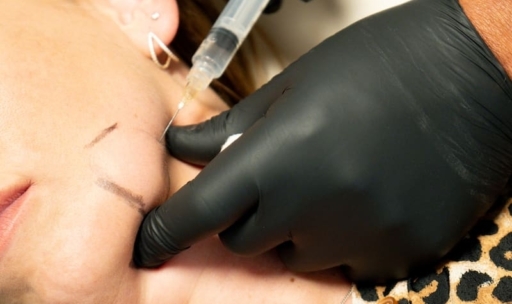
Aqualyx is introduced directly into an appropriately selected layer of subcutaneous fatty tissue.
Once within the treatment area, the deoxycholate-based formulation interacts with cell membranes. Fat cells within the treated tissue are disrupted, producing a local inflammatory response.
A human study examining sodium deoxycholate in subcutaneous fat found dose-dependent adipocyte lysis, inflammation, and subsequent phagocytosis of damaged fat cells by macrophages.
Research into the tissue-selective effects of injected deoxycholate has also explored why adipose tissue appears particularly susceptible to this detergent action.
The important point for patients is that the process involves cell disruption followed by biological clearance. The fat is not suctioned out, instantly dissolved, or simply passed directly out of the body after the appointment.
Clinical Note from Dr Nyla Raja
The mechanism is important because it explains both the results and the recovery. We are deliberately creating a controlled response within selected fatty tissue, so swelling and tenderness are not unexpected. Treatment needs to be placed at the appropriate depth and used in an area where reducing the fat is likely to improve the contour.
What Happens After Aqualyx Is Injected?
The visible treatment is only the beginning of the process.
During the first hours and days, patients commonly develop swelling and tenderness as the local inflammatory response becomes established. Bruising, redness, temporary firmness, and altered sensation can also occur.
Beneath the skin, damaged fat cells and surrounding cellular material begin to be cleared from the treatment area.
Over the following weeks:
- The acute inflammatory response gradually settles
- Damaged cellular material is cleared
- The treated fatty layer can progressively reduce
- The contour becomes easier to assess as swelling subsides
This is why photographs taken immediately after treatment cannot demonstrate the eventual result. During the early recovery period, the area may actually appear fuller than it did before treatment.

How Does the Body Clear Fat Cells After Aqualyx?
After the membranes of treated adipocytes are disrupted, immune cells participate in clearing the damaged tissue.
Macrophages are specialised cells involved in removing damaged cells and cellular debris. Histological research following deoxycholate injection has demonstrated macrophage activity and phagocytosis within treated fatty tissue.
The lipid contents and other cellular components released during this process are then handled through normal metabolic pathways.
This is more accurate than saying that the fat is simply “flushed out” or “expelled” from the body. The clearance process is biological and gradual.
The treated area therefore changes over time rather than immediately following injection.
When Does Aqualyx Start Working?
The biological response starts following treatment, but visible results take longer to develop.
During the first few days, swelling can obscure any reduction in the underlying fat. As this settles, some patients begin to notice contour change over approximately 3–6 weeks.
The effect of an individual session is generally easier to assess after approximately 6–8 weeks.
Many patients require more than one treatment. At Dr Nyla Medispa, treatment planning commonly involves approximately 2–4 sessions, although the number required depends on the area, volume of suitable fat, and response to treatment.
Our guide to Aqualyx results explains treatment spacing, swelling, when visible improvement typically develops, and why smaller and larger treatment areas can require different courses.
What Happens During an Aqualyx Treatment?
Treatment should begin with a consultation rather than with the injections themselves.
The practitioner needs to establish what is creating the unwanted contour and whether there is a suitable deposit of subcutaneous fat. This is particularly important because several different anatomical features can create an appearance that patients describe simply as “fat”.
The consultation may consider:
- The amount and distribution of subcutaneous fat
- Skin quality and elasticity
- The anatomy around the treatment area
- Medical history and current medicines
- Previous procedures
- Expected degree of improvement
- Whether another treatment would be more appropriate
If treatment is suitable, the area is planned and Aqualyx is introduced into the appropriate fatty layer using an injection technique suited to that region.
Appointment length varies according to the size and complexity of the area being treated. Patients should also plan for visible swelling afterwards rather than assuming that an injectable treatment necessarily means no recovery.
Our guide to Aqualyx safety, side effects, and aftercare explains the expected recovery in more detail, including swelling, bruising, tenderness, numbness, firmness, and when to contact the clinic.
What Areas Can Aqualyx Treat?
Aqualyx can be considered for selected pockets of subcutaneous fat in areas such as:
- Beneath the chin
- Selected lower-face or jawline fullness where fat is contributing
- Abdomen
- Flanks
- Upper arms
- Inner or outer thighs
- Around the knees
- Selected areas of the back
The treatment-area list should not be interpreted as meaning that every patient with fullness in these regions is suitable.
For example, fullness beneath the chin can result from a combination of fat, loose skin, chin projection, jaw structure, and neck anatomy. Abdominal contour can be influenced by subcutaneous fat, visceral fat, loose skin, and abdominal musculature.
Aqualyx can only address suitable subcutaneous fatty tissue.
Why Is Aqualyx Not a Weight-Loss Treatment?
Aqualyx treats a relatively small quantity of fat within a defined area. It is therefore intended to change local contour, not overall body weight.
A person can have a relatively stable weight and still have a persistent pocket of fat beneath the chin, around the abdomen, or in another specific area. This type of localised concern may be appropriate for body contouring.
Where excess fat is more widely distributed, repeatedly injecting individual areas is unlikely to be an appropriate substitute for weight management.
Aqualyx also does not treat deeper visceral fat around the internal organs.
The NHS information on obesity and weight management provides guidance where overall weight reduction rather than local contouring is the primary concern.

Who Is Suitable for Aqualyx?
Aqualyx is generally most relevant for someone with a relatively well-defined deposit of suitable subcutaneous fat and realistic expectations about the scale of non-surgical improvement possible.
Skin quality also matters. Aqualyx reduces fatty tissue but does not primarily tighten loose skin. Where significant laxity is present, reducing the volume underneath it may not create the result a patient expects.
Medical suitability must also be established before treatment. Aqualyx should not be performed during pregnancy or breastfeeding, and other health conditions or medicines can affect whether treatment is appropriate.
Our detailed guide to Aqualyx suitability explains who tends to be a good candidate, when treatment should be avoided, and when another approach may be more appropriate.
Why Does Aqualyx Cause Swelling?
Swelling occurs because Aqualyx intentionally creates a local response within treated fatty tissue.
Research on injected deoxycholate has demonstrated inflammation alongside adipocyte disruption. This means swelling is not simply an accidental consequence of the needle entering the skin.
Other expected short-term effects can include:
- Tenderness
- Bruising
- Redness
- Warmth
- Temporary firmness or areas of hardness
- Numbness or altered sensation
These effects generally improve as the treatment area settles. More significant complications are uncommon but possible, which is why patients should receive clear aftercare instructions and access to clinical follow-up.
If symptoms are unusually severe, progressively worsening, or associated with significant skin changes, discharge, fever, or other unexpected symptoms, the treating clinic should be contacted.
Are There Alternatives to Aqualyx?
Yes. The most appropriate option depends on the type and amount of fat, treatment area, skin quality, and the degree of change required.
CoolSculpting, for example, uses controlled cooling rather than injections to reduce susceptible subcutaneous fat. It can be useful for some larger pinchable body areas where an applicator can be positioned appropriately.
Where loose skin rather than excess fat is the main issue, skin-tightening treatment may be more relevant.
Where a substantial reduction in fat is required, liposuction can produce a considerably greater change because it physically removes fatty tissue surgically. Aqualyx should not be presented as a direct equivalent to liposuction.
Choosing between these approaches should follow assessment of the underlying anatomy rather than simply selecting the treatment with the most appealing mechanism.

Book in a Free Consultation With Our Expert Team
- Award-winning, doctor-led aesthetic clinics
- Locations in London, Cheshire, and Liverpool
- Over 50 non-surgical treatments available
- Free consultation with a personalised plan
How Aqualyx Works: FAQs
Does Aqualyx melt fat?
“Fat melting” is a simplified description. Aqualyx uses a deoxycholate-based formulation that disrupts cells within appropriately treated fatty tissue. The resulting cellular material is then gradually cleared through biological processes.
Does Aqualyx use an acid that naturally occurs in the body?
Deoxycholic acid is a naturally occurring bile acid involved in dietary fat digestion. In injectable fat reduction, however, the relevant effect is its detergent-like ability to disrupt cell membranes rather than simply reproducing normal digestion beneath the skin.
Where does the fat go after Aqualyx?
Damaged fat cells and cellular debris are gradually cleared by inflammatory and immune processes. Their components are subsequently handled through normal metabolic pathways. They are not simply flushed directly out of the body immediately after treatment.
Does Aqualyx work immediately?
No. Swelling usually occurs first, and visible contour change develops progressively over the following weeks.
How long does Aqualyx take to work?
Some visible improvement may begin over approximately three to six weeks. The result of an individual session is usually easier to assess after around six to eight weeks.
How many Aqualyx treatments are needed?
Many patients require approximately two to four sessions, although smaller areas can sometimes need fewer and larger deposits may require a longer course.
Does Aqualyx get rid of fat permanently?
Successfully disrupted fat cells are removed from the treated tissue rather than temporarily shrinking. However, remaining fat cells can enlarge with future weight gain, so maintaining a relatively stable weight remains important.
Can Aqualyx treat stomach fat?
It can be considered for selected pinchable subcutaneous abdominal fat. It does not treat visceral fat deeper within the abdomen, substantial loose skin, or abdominal shape caused primarily by muscle separation.
Is Aqualyx painful?
Patients can experience stinging, tenderness, and discomfort during or after treatment. The level of discomfort varies between individuals and treatment areas. It should not be described as universally pain-free.
Is there downtime after Aqualyx?
Many patients can continue normal day-to-day activities, but this does not mean there are no visible effects. Swelling, tenderness, and bruising can be noticeable for several days and occasionally longer.
How Aqualyx Works: The Importance of Appropriate Treatment
Aqualyx works by creating a controlled response within selected subcutaneous fatty tissue. Its deoxycholate-based formulation disrupts treated fat cells, after which the body gradually clears damaged cellular material and the local contour can progressively change.
The mechanism also explains why results are not immediate and why swelling, tenderness, and temporary firmness are common after treatment.
Aqualyx has a relatively specific role. It can be useful for selected pockets of localised fat, but it does not treat general excess weight, visceral fat, significant skin laxity, or every cause of unwanted fullness.
The starting point should therefore be an individual assessment of the treatment area rather than an assumption that any visible fat can simply be dissolved.
If you are considering treatment, you can book a free consultation at Dr Nyla Medispa to discuss the area you would like to treat, your suitability, and whether Aqualyx or another body-contouring treatment is more appropriate.
Need Guidance in Selecting the Most Appropriate Treatment?
Related Treatments
Aqualyx Fat Dissolving Injections

CoolSculpting Fat Freezing
Emerald Laser Fat Loss
LIPOcel Body Contouring

EMSCULPT Body Sculpting

About the Author
Considering treatment? Book a free consultation at our clinics in Mayfair London, Alderley Edge Cheshire, or Crosby Liverpool, or call 0800 009 6661.