
Dermal Fillers Explained: What They Are, How They Work, and What They Can Treat

Clinical guidance from Dr Nyla Raja MBChB (Hons), MRCGP (Dist), DFFP, DPDermatology - GMC No. 6057913
Dermal Fillers Explained: At a Glance
Dermal fillers are injectable gel products used to restore selected areas of facial volume, provide structural support, and refine facial contours. Many of the temporary fillers used in facial aesthetic medicine are based on hyaluronic acid, a substance naturally present within the skin and connective tissues.
Unlike Botox, dermal fillers do not primarily work by reducing muscle activity. Their effect is physical: carefully placed filler can occupy space within facial tissues, support particular anatomical areas, improve projection, or soften selected hollows and folds.
The appropriate use of filler depends on understanding why a facial concern is present. Age-related volume loss, skeletal structure, fat distribution, skin laxity, muscle activity, and skin quality can all create different visible changes and should not automatically be treated in the same way.
- What dermal fillers are: injectable gels used to alter volume, support, projection, and contour
- Most common temporary type: hyaluronic acid filler
- How they work: by physically occupying and supporting selected areas within facial tissues
- Common treatment areas: lips, cheeks, chin, jawline, tear troughs, nasolabial folds, marionette lines, temples, and nose
- Volume restoration: replaces selected age-related volume or support
- Facial contouring: changes visible shape or proportion, even where significant volume loss is not present
- What filler does not do: remove significant loose skin, treat pigmentation, reduce dynamic muscle activity, or directly improve every aspect of skin quality
- Results: are often visible immediately, although swelling means the initial appearance is not the final result
Dermal filler treatment should be planned following assessment of facial anatomy, tissue quality, medical history, suitability, and the intended outcome. More filler is not inherently better, and not every facial concern should be treated with an injectable.
What Are Dermal Fillers?
Dermal fillers are injectable gel products used to create or restore volume within selected areas of the face.
Depending on the product and placement, filler can be used to support facial contours, replace selected areas of age-related volume loss, improve projection, soften hollows, or alter visible proportions.
The term “dermal filler” can be slightly misleading because filler is not always placed directly within the dermis. Depending on the anatomical area and treatment objective, a practitioner may place filler at different tissue depths.
This is why filler treatment should not be thought of as simply “filling wrinkles”. Modern facial treatment is more often based on understanding structure, tissue compartments, proportion, and how different areas of the face relate to one another.

What Is Hyaluronic Acid Filler?
Hyaluronic acid is a naturally occurring polysaccharide found within the skin, connective tissue, and joints. It has an important role in tissue hydration and extracellular structure.
Hyaluronic acid dermal fillers contain manufactured hyaluronic acid formulated into injectable gels. Many products are cross-linked, which alters the way the gel behaves and allows it to persist within tissues for longer than naturally occurring hyaluronic acid.
Different formulations have different physical properties. Some are designed to provide greater projection or structural support, while others are softer and more flexible for areas where natural movement is particularly important.
Not all injectable aesthetic products are hyaluronic acid fillers. For example, Sculptra contains poly-L-lactic acid and is primarily used as a collagen-stimulating injectable rather than as a conventional hyaluronic acid gel. Different products should therefore not be treated as interchangeable simply because they are injected into the face.
How Do Dermal Fillers Work?
Hyaluronic acid filler works primarily through its physical presence within the tissue.
Once injected, the gel occupies space and interacts with the surrounding tissues. Depending on where and how it is placed, this can:
- Restore volume in a hollow or depleted area
- Provide projection to a facial feature
- Improve structural support around a contour
- Soften the transition between neighbouring facial areas
- Reduce the appearance of selected folds or depressions
- Alter facial proportions through carefully planned contouring
Although hyaluronic acid attracts water, describing dermal filler simply as a “hydrating treatment” understates its main role. The clinically important effect of conventional facial filler is generally volume, shape, projection, and support.
Clinical Note from Dr Nyla Raja
Good filler treatment starts with anatomy rather than the wrinkle itself. A visible fold may be influenced by support from the cheek, the position of facial fat, skeletal structure, skin quality, or several factors together. Injecting directly into the line is not always the most appropriate solution.
How Do Fillers Sit Within Facial Tissue?
The face is made up of several layers, including skin, superficial and deeper fat compartments, connective tissues, muscles, and bone.
Filler can be placed at different depths depending on the area being treated and the result being sought. A deeper placement close to bone may be selected where structural projection is required, while other treatments may involve a more superficial tissue plane.
Once placed, the gel does not simply remain as a free-floating pocket of liquid. It sits within and interacts mechanically with the surrounding tissues.
The correct depth matters because different parts of the face contain important blood vessels, nerves, muscles, glands, and other structures. Understanding the anatomy of the treatment area is therefore central to both the aesthetic result and safety.
Why Does Facial Volume Change With Age?
Facial volume loss is only one component of facial ageing.
Changes can occur simultaneously within several anatomical layers:
- Facial fat compartments can lose volume or change position
- Bone structure changes gradually with age
- Ligaments and connective tissues can provide less effective support
- Skin becomes thinner and loses collagen and elasticity
- Repeated movement contributes to expression lines
- Changes in fat distribution can alter facial contours
This explains why simply adding filler everywhere that appears hollow is not an appropriate strategy.
In some patients, restoring carefully selected areas of support can improve facial balance. In others, significant skin laxity, tissue descent, or skin-quality change may be more important than volume loss, making filler less useful.
Volume Restoration vs Facial Contouring
Dermal filler is used for both volume restoration and facial contouring, but these are not the same objective.
Volume Restoration
Volume restoration aims to replace selected volume or support that has changed with ageing.
A patient who has developed midface hollowing, for example, may benefit from strategic restoration of cheek support where this is anatomically appropriate.
Facial Contouring
Contouring aims to alter visible shape, projection, or proportion.
This may be appropriate in a younger patient who has no meaningful age-related volume loss but would like greater chin projection, more defined cheek structure, or a different jawline contour.
The distinction matters because the same quantity of filler can have very different purposes depending on why it is being used.
Common Dermal Filler Treatment Areas
Lips
Lip filler can be used to restore or add volume, improve selected aspects of definition, support lip proportions, or address asymmetry.
The aim does not have to be visibly larger lips. In some patients, conservative treatment is used primarily to restore structure that has changed with age.

Cheeks and Midface
Cheek filler can be used for structural contouring or to restore selected areas of midface volume.
Cheek treatment can also influence the transition between the lower eyelid and cheek or provide support to surrounding tissues. This does not mean that cheek filler universally “lifts” the face.
Chin
Chin filler can alter projection, length, symmetry, and the visual relationship between the chin, lips, and jawline.
This is typically a contouring treatment rather than replacement of age-related volume.
Jawline
Jawline filler can add definition or structural support in selected patients.
The result depends heavily on the existing jaw, chin projection, facial fat, and skin laxity. Filler cannot remove excess lower-face fat or significantly tighten loose skin.
Tear Troughs and Under-Eyes
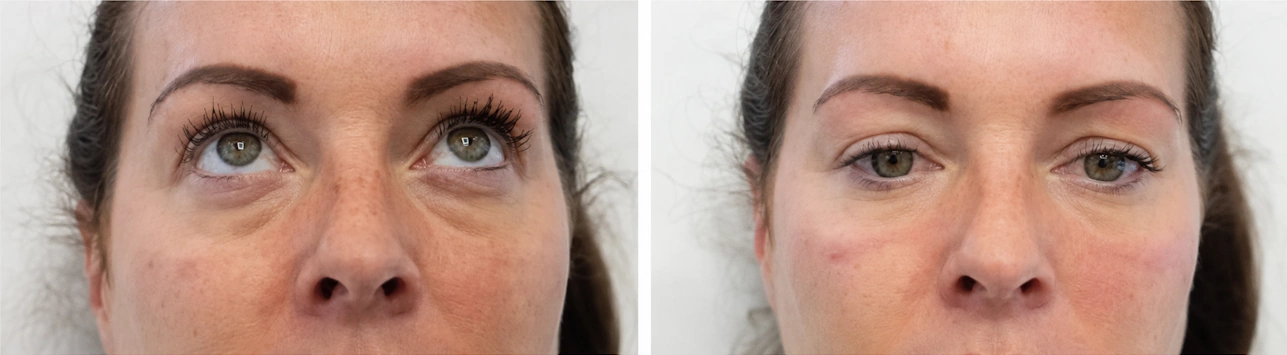
Tear trough filler can be considered where a true under-eye hollow is contributing to shadowing.
Not all dark circles or eye bags are caused by volume loss. Pigmentation, thin skin, fluid retention, prominent fat pads, and skin laxity can all affect the area, so careful patient selection is particularly important.
Nasolabial Folds
Nasolabial folds extend from the side of the nose towards the mouth.
Their appearance can reflect facial anatomy, midface support, tissue movement, and skin changes. Directly filling the fold is not always the most appropriate approach.
Marionette Lines
Marionette lines can be influenced by lower-face volume, chin structure, tissue descent, skin quality, and muscular movement.
Filler may form one part of treatment where structural support is required, but the cause should be assessed first.
Temples
Temple hollowing can develop through changes in soft tissue volume with age. Carefully selected filler can restore volume in suitable patients, although the anatomy of this area makes practitioner expertise particularly important.
Nose
Non-surgical nose reshaping uses filler to alter selected aspects of nasal contour.
It can disguise certain irregularities or improve proportion but cannot make a large nose physically smaller, narrow nasal bones, correct breathing problems, or reproduce every result achievable through surgical rhinoplasty.
Multi-Area Facial Balancing
Some patients benefit from treating several areas in combination rather than focusing on an isolated feature. The 8 Point Facelift is one example of a multi-area approach to facial support and balancing.
This should not be interpreted as a fixed number of syringes or a standard pattern suitable for every face. The amount and location of filler should remain individualised.
What Can Dermal Fillers Realistically Achieve?
In appropriately selected patients, dermal fillers can:
- Restore selected areas of facial volume
- Improve cheek, chin, or jawline projection
- Refine facial proportions
- Soften selected hollows and depressions
- Support the transition between facial areas
- Improve lip volume or definition
- Reduce the appearance of certain folds
- Alter selected aspects of nasal contour without surgery
- Improve facial balance through multi-area treatment
Strategic structural support can sometimes create a visual lifting effect, but dermal filler does not physically tighten or remove loose skin in the way surgery can.
Natural-looking results depend not only on the amount used but also on product selection, tissue depth, placement, facial proportions, and knowing when not to add further volume.
What Dermal Fillers Cannot Do
Dermal fillers cannot appropriately correct every sign of facial ageing.
They cannot:
- Remove significant loose or excess skin
- Directly treat pigmentation
- Reliably correct every type of under-eye bag or dark circle
- Reduce dynamic wrinkles caused primarily by muscle activity
- Remove facial fat
- Permanently alter underlying bone
- Replace surgical lifting where significant tissue laxity is present
- Reproduce the complete structural changes possible with surgical rhinoplasty
- Correct poor skin texture simply by adding more facial volume
For example, jowling may involve volume loss, tissue descent, skin laxity, fat distribution, and skeletal changes. Adding filler directly into a heavy lower face can sometimes worsen rather than improve the appearance if the underlying anatomy has not been properly assessed.
Dermal Fillers vs Skin-Quality Treatments
Facial volume and skin quality are related, but they are not the same thing.
Dermal filler primarily changes volume, support, shape, and contour.
Skin-quality treatment is more concerned with characteristics such as texture, elasticity, hydration, pigmentation, fine crepiness, and surface smoothness.
A patient can have excellent facial volume but poor skin quality. Equally, someone can have healthy skin but meaningful structural volume loss.
Depending on the concern, treatments such as skin boosters, Profhilo, polynucleotides, microneedling, chemical peels, or medical-grade skincare may be considered where the treatment objective is primarily skin quality.
These treatments are not substitutes for structural volume replacement, just as adding structural filler is not a substitute for treating pigmentation or skin texture.
Clinical Note from Dr Nyla Raja
One of the most important distinctions in facial treatment is whether we are addressing structure or skin quality. Adding volume to a face that does not need additional volume will not improve pigmentation, crepiness, or surface texture. The treatment should match the anatomical problem.
Why Are Different Dermal Filler Products Used?
Hyaluronic acid fillers are not all physically identical.
Products can vary in firmness, elasticity, cohesivity, flexibility, and how strongly they attract water. These characteristics influence where a filler may be most appropriate.
A product selected for deeper cheek or chin projection may need different properties from one used in a highly mobile area such as the lips.
Established hyaluronic acid filler ranges include products within brands such as Juvéderm, Restylane, Teosyal, and Belotero. Product choice should be based on the treatment objective, anatomy, and clinical judgement rather than brand recognition alone.
How Much Dermal Filler Is Needed?
There is no standard volume that every patient should receive.
One millilitre is a common syringe size, but the amount required depends on the area, anatomy, starting volume, product used, and treatment objective.
A subtle lip treatment may require a very different volume from multi-area facial restoration. Equally, a multi-area treatment should not be defined by a predetermined syringe target.
More product does not automatically create a better result. Excessive or poorly distributed volume can distort natural proportions and make the face appear heavier.
When Are Dermal Filler Results Visible, and How Long Do They Last?
Many dermal filler results are visible immediately after treatment because the gel physically changes the treated area as soon as it is placed.
The initial appearance is not necessarily the final result. Swelling, mild bruising, tenderness, and temporary asymmetry can occur, particularly during the first few days.
Longevity varies considerably according to:
- The treatment area
- The filler product
- The amount and depth of placement
- Facial movement
- Individual metabolism and tissue characteristics
- Previous treatment
Our guide to how long dermal fillers last explains these factors in more detail.
Hyaluronic acid filler can also be broken down using hyaluronidase where clinically appropriate. However, dissolving filler should not be regarded as a simple or completely risk-free “undo button”. It is a clinical procedure requiring its own assessment.
Are Dermal Fillers Safe?
Dermal fillers are widely used, but injectable treatment carries recognised risks.
Common temporary effects include:
- Swelling
- Bruising
- Tenderness
- Redness
- Temporary asymmetry
Less common complications can include infection, persistent swelling, nodules, inflammatory reactions, and unwanted product placement.
Vascular occlusion is an uncommon but important complication in which filler compromises blood flow within a vessel. Prompt recognition and management are essential. Very rare but serious visual complications have also been reported following filler injection in high-risk facial areas.
These risks make practitioner anatomy knowledge, product selection, injection technique, assessment, and access to appropriate complication management particularly important.
The NHS guidance on choosing a cosmetic practitioner recommends checking qualifications, training, experience, insurance, and aftercare arrangements before proceeding.
At Dr Nyla Medispa, dermal filler treatments are performed exclusively by GMC-registered doctors within a medically regulated clinic. Our dedicated guide to dermal filler safety explains recognised risks and practitioner considerations in greater detail.
What Happens at a Dermal Filler Consultation?
A consultation should establish what is creating the concern before discussing how much filler might be required.
Assessment may include:
- Medical history and medicines
- Previous injectable treatments
- Facial proportions at rest and in movement
- Areas of volume loss
- Bone and soft-tissue structure
- Skin laxity and skin quality
- Existing facial asymmetry
- The treatment result you are hoping to achieve
- Whether filler is actually the most appropriate treatment
The treatment plan can then distinguish between restoring lost volume, contouring an existing feature, supporting facial structure, and improving skin quality.
Practical guidance after treatment is covered in our dermal filler aftercare guide.

Book in a Free Consultation With Our Expert Team
- Award-winning, doctor-led aesthetic clinics
- Locations in London, Cheshire, and Liverpool
- Over 50 non-surgical treatments available
- Free consultation with a personalised plan
Dermal Fillers Explained: FAQs
Do dermal fillers stretch the skin?
Appropriately selected filler does not simply stretch the skin in the way an inflated balloon would. The effect depends on product, volume, tissue plane, and anatomy. Excessive or repeated overfilling can, however, distort facial proportions and should be avoided.
Do hyaluronic acid fillers stimulate collagen?
The principal effect of a conventional hyaluronic acid filler is the physical presence of the gel and the volume or support it creates. Any wider biological effects should not be confused with the mechanism of dedicated collagen-stimulating injectables.
Can dermal filler lift the face?
Strategically restoring support can sometimes create a visual lifting effect, but filler does not physically tighten loose skin or reproduce a surgical facelift.
Can filler get rid of jowls?
Not in every patient. Filler may improve chin, jawline, or pre-jowl support where structural deficiency contributes to the appearance, but it does not remove loose skin or lower-face fat.
Can under-eye filler treat eye bags?
Only selected under-eye concerns are suitable for filler. True hollowing may respond, but pigmentation, fluid retention, prominent fat pads, and significant skin laxity require different assessment and may not be improved by adding volume.
Is dermal filler the same as Botox?
No. Botox temporarily reduces activity in selected muscles. Dermal filler changes volume, support, projection, or contour. They address different anatomical causes.
Are skin boosters the same as dermal fillers?
No. Although some skin boosters contain hyaluronic acid, their treatment objective is generally skin quality rather than structural facial contouring or volume replacement.
Can filler improve skin texture?
Filler can alter the way light falls across a hollow or contour, which may make the surface appear smoother. It does not directly treat pigmentation, pores, sun damage, or broader textural concerns in the same way as treatments designed specifically for skin quality.
What is the best dermal filler?
There is no single best filler for every patient or facial area. The appropriate product depends on anatomy, treatment depth, tissue movement, the degree of support required, and the intended result.
Can dermal fillers be dissolved?
Hyaluronic acid fillers can be treated with hyaluronidase where clinically appropriate. Dissolving treatment has its own indications and risks and should be performed following clinical assessment.
Dermal Fillers: Structure, Volume, and Individual Treatment Planning
Dermal fillers are most useful when they are used for a clearly defined structural purpose. Hyaluronic acid gels can restore selected areas of volume, improve projection, support facial contours, and refine proportions when the underlying anatomy makes filler appropriate.
Their limitations are equally important. Filler cannot remove significant loose skin, treat every under-eye concern, correct pigmentation, reduce muscle-driven expression lines, or replace a treatment designed specifically to improve skin quality.
Successful treatment therefore depends less on filling every visible line and more on identifying whether the underlying issue is volume loss, structural proportion, tissue support, muscle activity, skin laxity, or skin quality.
If you are considering dermal filler treatment, you can book a free consultation to discuss your concerns, suitability, facial anatomy, and an individual treatment plan.
Need Guidance in Selecting the Most Appropriate Treatment?
Related Treatments

Dermal Fillers

Jawline Fillers

Lip Fillers

Tear Trough Fillers

Dermal Fillers for Men

About the Author
Dr Nyla Raja | Founder & Medical Director
GMC-registered doctor with over 20 years of clinical experience in aesthetic medicine. Qualifications include MBChB (Hons), MRCGP (Dist), DFFP, and DPDermatology. Member of the British College of Aesthetic Medicine (BCAM).