
How Much Do Tear Trough Fillers Cost in the UK? 2026 Price Guide

Clinical guidance from Dr Nyla Raja MBChB (Hons), MRCGP (Dist), DFFP, DPDermatology - GMC No. 6057913
Tear Trough Filler Cost in the UK: At a Glance
Tear trough filler, also commonly called under-eye filler, typically costs approximately £300–£500 per treatment at established UK clinics. Prices can sit below or above this range depending on the practitioner, clinic location, product used, amount of filler required, and whether treatment of the cheeks or midface is also recommended.
Tear trough treatment is usually performed with a carefully selected hyaluronic acid dermal filler and tends to use relatively conservative volumes. Some clinics price treatment by anatomical area, while others charge according to the syringe or amount of product opened. The lowest advertised price therefore does not always represent the complete treatment plan.
At Dr Nyla Medispa, tear trough filler treatment starts from £350. Our pricing reflects treatment exclusively by GMC-registered doctors within a medically regulated clinic, with an individualised approach based on your assessment, suitability, facial anatomy, and desired outcome. Final pricing is provided following a free consultation before treatment.
- Typical UK tear trough filler price: approximately £300–£500 per treatment
- Higher-priced treatment: can exceed £500 where practitioner fees, additional product, or a more extensive treatment plan applies
- Product amount: commonly conservative; more filler beneath the eye is not automatically better
- Cheek or midface support: may be considered where loss of support contributes to the under-eye hollow
- Dr Nyla Medispa: dermal filler from £350
- Practitioner at Dr Nyla Medispa: GMC-registered doctor
- Consultation at Dr Nyla Medispa: free
These figures are general UK market guidance rather than individual quotations. Tear trough filler should be planned according to anatomy and suitability rather than according to a predetermined volume of product.
How Much Does Tear Trough Filler Cost in the UK?
Approximately £300–£500 is a useful current guide for a standard tear trough or under-eye filler treatment at many established UK clinics.
The broader market extends beyond this range. Some clinics advertise lower starting prices, while treatment with senior medical practitioners, premium clinics, or a more extensive treatment plan can cost £500 or more.
This makes a pricing range more useful than quoting one national “average”. Clinics also structure their prices differently: one provider may quote by syringe, another by treatment area, and another according to a complete under-eye and midface treatment plan.
Tear trough treatment sits within the wider dermal filler market, so patients comparing injectable costs may also find our guide to dermal filler cost in the UK useful for understanding how prices vary according to treatment area, product quantity, practitioner experience, and clinic setting.
| Treatment / Pricing Structure | Typical UK Guide | Dr Nyla Medispa | What to Check |
|---|---|---|---|
| Tear trough / under-eye filler | Approximately £300–£500 | From £350 | Product quantity, practitioner, treatment area, consultation, review, and aftercare |
| Higher-volume treatment | Usually higher than a standard single-syringe treatment | Individual treatment plan | Total amount of filler and whether product is being used in the tear trough, cheek, or both |
| Cheek and tear trough treatment | Usually higher than tear trough treatment alone | Individual treatment plan | Midface support required, total filler volume, and the areas being treated |
| Consultation | Free at some clinics; charged separately at others | Free | Who performs the assessment and whether any consultation fee is separate or redeemable |
| Previous filler correction | Usually assessed and charged separately | Confirmed following assessment | Whether previous filler needs to be dissolved or otherwise managed before further treatment |
These figures are indicative rather than fixed quotations. Combined treatments and correction cases vary particularly widely because the appropriate plan depends on anatomy, previous treatment, and the amount and location of filler required.
How Is Tear Trough Filler Priced?
There is no single pricing system used by every UK clinic.
Tear trough filler may be priced:
- Per syringe: according to the amount of hyaluronic acid filler opened for treatment
- Per anatomical area: as one price for treatment of the tear trough region
- By treatment plan: where under-eye and cheek or midface treatment are considered together
- By practitioner: with different fees for practitioners with different levels of seniority or experience
This means two prices cannot always be compared directly.
A £300 quotation based on one syringe is not necessarily equivalent to a £450 treatment that includes a specialist consultation, a different filler product, clinical review, and more extensive midface assessment.
Likewise, a more expensive quotation may involve treatment of more than the tear trough itself.
How Much Filler Is Usually Needed for the Tear Trough?
Tear trough filler is an area where more product is not necessarily better.
The skin and soft tissue beneath the eyes are thin, and hyaluronic acid fillers attract water to varying degrees. Excessive volume or inappropriate product placement can contribute to persistent puffiness, visible irregularity, or a blue-grey appearance known as the Tyndall effect.
Published clinical research on tear trough filler treatment involving more than 1,400 applications found that relatively conservative volumes were commonly used, with the amount adjusted according to individual anatomy.
A patient may therefore be charged according to a 1ml syringe without necessarily requiring the entire millilitre to be placed directly beneath the eyes.
Is 1ml of Under-Eye Filler a Lot?
There is no universal volume that is correct for every patient.
Some patients require relatively small amounts across both sides. Others may have more extensive midface volume loss requiring a broader treatment plan. The appropriate quantity depends on anatomy rather than the patient’s desire to receive a particular number of millilitres.
Deeper under-eye hollows do not automatically mean that more filler should be placed directly into the tear trough.
Clinical Note from Dr Nyla Raja
The under-eye area should be treated conservatively. The objective is not to use as much product as possible, but to soften the hollow while respecting the anatomy of the lower eyelid and midface. In some patients, the appropriate decision is to use very little filler, support the cheek first, or not inject the tear trough at all.
Why Does Tear Trough Filler Cost Vary?
Several clinical and practical factors influence the cost of under-eye filler.
Product Choice
Hyaluronic acid dermal fillers differ in properties such as firmness, cohesivity, and water affinity. A product selected for structural cheek or jawline treatment is not automatically appropriate for the lower-eyelid area.
There is therefore no single universally “best tear trough filler”. Product selection should reflect anatomy, skin quality, the treatment plane, and the practitioner’s intended technique. Patients who want to understand this in more detail can read our guide to the different types of dermal fillers used around the eyes and tear troughs.
Amount of Filler Required
The quantity of product affects cost where clinics charge per syringe.
However, the objective should not be to purchase as much filler as possible. Conservative treatment is particularly important beneath the eyes.
Practitioner Experience
The tear trough is a technically demanding area. Clinics treating this region with experienced medical injectors may charge more than providers using a more generalised filler pricing structure.
Clinic Location and Setting
Central London and some premium medical clinics tend to sit towards the higher end of UK pricing, although there is substantial overlap between regions. Location alone is not a measure of treatment quality.
Patients specifically comparing prices in the capital can also read our guide to dermal filler cost in London, which looks more broadly at London filler pricing, practitioner factors, treatment areas, and what can influence the final quotation.
Consultation and Follow-Up
Some prices include consultation, aftercare, and a review appointment. Other providers charge for these separately.
It is therefore useful to compare the complete clinical service rather than the injection fee alone.
Can Cheek Support Affect the Cost of Tear Trough Filler?
Yes. The tear trough forms part of the wider relationship between the lower eyelid and midface.
In some patients, loss of support or volume in the upper cheek makes the under-eye hollow appear more pronounced. Treating the tear trough alone may therefore be less appropriate than considering the midface as part of the assessment.
Published clinical literature on tear trough and infraorbital rejuvenation describes the importance of evaluating the wider midface when planning treatment.
This does not mean that everyone having under-eye filler requires cheek filler. Where cheek volume loss is contributing to the appearance, the wider relationship between the cheek and lower eyelid should be assessed before deciding which areas to treat.
The assessment should consider:
- Upper-cheek projection and support
- Midface volume loss
- Depth and extent of the tear trough
- Lower-eyelid fat pads
- Skin thickness and laxity
- Fluid retention or malar oedema
- Overall facial proportions
If cheek support is clinically appropriate, the total treatment cost will generally be higher because an additional area and additional filler are being treated.
The quotation should make this distinction clear rather than presenting cheek treatment as though it were automatically part of standard tear trough filler.
Is Under-Eye Filler Suitable for Eye Bags, Dark Circles, and Hollow Eyes?
Not every concern described as “dark circles”, “eye bags”, “sunken eyes”, or “tired eyes” has the same cause. Our page on eye rejuvenation treatments explains why different under-eye concerns may require different treatment approaches.
Tear trough filler is most relevant where genuine under-eye hollowing or volume loss contributes to a visible depression or shadow.
Under-Eye Hollows
Hollowing is one of the clearest reasons tear trough filler may be considered. Appropriate filler placement can soften the transition between the lower eyelid and cheek in selected patients.
For a broader explanation of treatment, suitability, expected results, and the treatment process, see our guide to dermal eye fillers and tear trough treatment.
Dark Circles
Under-eye filler may improve dark circles where shadowing caused by a hollow is an important component.
It will not directly correct pigmentation, visible blood vessels, or every cause of under-eye darkness. Treating a pigmentary concern as though it were simply volume loss is unlikely to provide the intended result.
Eye Bags and Puffiness
Filler does not remove lower-eyelid fat. In selected patients, it may soften the transition around mild prominence, but significant puffiness, fluid retention, festoons, or lower-eyelid fat prolapse can make direct filler less appropriate.
Because hyaluronic acid can attract water, careful patient selection is particularly important where swelling is already present. Patients whose primary concern is puffiness rather than hollowing may find our guide to under-eye bags treatment useful for understanding the different causes and non-surgical treatment options.
Fine Lines and Crepey Skin
Fine lines and thin, crepey under-eye skin are not always caused by volume loss. Where skin quality is the main concern, adding dermal filler may not be the most appropriate solution.
In suitable patients, regenerative approaches such as polynucleotide treatment may be considered where the objective is to improve skin quality rather than replace volume.
A consultation should establish what is actually contributing to the under-eye appearance before a treatment and price are recommended.
Why Practitioner Experience Matters for Tear Trough Filler
The tear trough is a technically demanding injectable area because of the thin lower-eyelid tissues and important vascular anatomy surrounding the orbit.
Short-term swelling, tenderness, and bruising can occur following treatment. Other recognised problems include persistent oedema, contour irregularity, asymmetry, visible filler, Tyndall effect, nodules, and infection.
Vascular occlusion is uncommon but potentially serious. Rare visual complications associated with facial filler injections have also been documented in medical literature.
For this reason, practitioner experience should be considered alongside cost.
The practitioner should understand:
- Lower-eyelid and midface anatomy
- Appropriate patient selection
- Different filler characteristics
- Conservative volume selection
- Appropriate injection techniques and treatment planes
- Recognition of vascular complications
- Assessment of persistent swelling or irregularity
- When hyaluronidase may be required
- When tear trough treatment should be declined
Patients considering treatment can read more about these considerations in our guide to tear trough and dermal eye filler safety.
The NHS guidance on choosing a cosmetic practitioner advises patients to consider qualifications, training, experience, insurance, aftercare arrangements, and what happens if something goes wrong.
At Dr Nyla Medispa, dermal filler procedures are performed exclusively by GMC-registered doctors within a medically regulated clinical setting.
Clinical Note from Dr Nyla Raja
Tear trough treatment is not simply a matter of filling a visible line. We assess the lower eyelid, cheek support, skin quality, and tendency towards puffiness before deciding whether filler is appropriate. Patient selection is as important as injection technique in this area.

Consultation and Review Arrangements
Consultation and review arrangements can influence the true cost of tear trough filler.
Consultation
Some UK clinics provide a complimentary consultation, while others charge separately or make the consultation fee redeemable against treatment.
For tear trough treatment, the consultation should assess more than the depth of the visible hollow.
It should consider:
- Your medical history
- Previous dermal filler treatment
- Previous problems with swelling
- The cause of the under-eye concern
- Lower-eyelid anatomy
- Skin quality and laxity
- Cheek and midface support
- The filler product and quantity being proposed
- Expected benefits and limitations
- Potential side effects and complications
- Alternative treatments where appropriate
- The complete treatment cost
The NHS guidance before having a cosmetic procedure recommends understanding the costs, risks, aftercare, and what may happen if further treatment is needed.
Review Appointment
A review can be useful because swelling needs time to settle before the result can be assessed properly.
A conservative first treatment followed by reassessment is often preferable to attempting to correct every visible hollow with a larger amount of filler at the initial appointment.
However, an included review does not automatically mean additional filler is included without charge.
Before proceeding, establish:
- Whether a review is included
- When the review should take place
- Whether additional filler is charged separately
- Whether correction or dissolving would involve a separate fee
At Dr Nyla Medispa, a free consultation is available before treatment so that suitability, anatomy, treatment planning, and likely cost can be discussed before you decide whether to proceed.
What Should Be Included in a Tear Trough Filler Quote?
A clear quotation should describe the complete treatment being recommended rather than simply stating “under-eye filler from £X”.
Before proceeding, it should be clear:
- Which area is being treated: tear trough alone, cheeks, or a combined midface plan
- Whether both sides are included: treatment usually considers the under-eye area bilaterally, but this should be confirmed
- How much product is included: for example, whether the fee is based on one syringe
- Which filler is being used: and why it is appropriate for the area
- Who will perform treatment: including professional registration and relevant experience
- Whether consultation is included
- Whether a review is included
- Whether additional product at review is separately charged
- What aftercare and clinical support are available
- What happens if a complication develops
- Whether correction or dissolving is separately charged
- The total expected cost: particularly where cheek or midface support is also proposed
This makes it possible to compare equivalent treatment plans rather than unrelated headline prices.
What If Previous Under-Eye Filler Needs Correcting?
Some patients seek assessment because previous tear trough filler has resulted in persistent swelling, visible product, asymmetry, contour irregularity, migration, or a blue-grey Tyndall effect.
Where hyaluronic acid filler is contributing to the problem, hyaluronidase may sometimes be considered to dissolve the filler before further treatment is planned.
Correction should not automatically mean dissolving the product and immediately replacing it.
The clinician first needs to understand:
- Which product was previously used
- When treatment was performed
- Where the filler appears to be positioned
- Whether swelling, migration, or another problem is present
- Whether further tear trough filler remains appropriate
Published clinical research on delayed tear trough filler complications describes problems including swelling, contour changes, and other delayed presentations that may require specialist assessment.
Correction and dissolving are generally treated as separate clinical services, so patients with previous filler should establish whether this will add to the overall cost before further treatment is planned.
For a broader explanation of injectable risks and complication management, see our guide to dermal filler safety.
Why Headline Tear Trough Filler Cost Alone Is a Poor Comparison
A clinic advertising “tear trough filler from £250” and another charging £450 may be offering very different services.
The headline price alone does not tell you:
- Who will perform the treatment
- How experienced they are with the under-eye area
- Which filler product will be used
- How much product is included
- Whether both under-eye areas are included
- Whether cheek support has been assessed
- Whether consultation is included
- Whether review is included
- Whether further product at review costs extra
- What clinical support is available if a concern develops
- Whether previous filler requires correction first
A lower price does not automatically indicate poorer treatment, and a higher price does not guarantee a better result.
The more useful comparison is between equivalent treatment plans, practitioner expertise, product selection, clinical standards, and follow-up arrangements.
This is particularly important with under-eye filler because conservative treatment and appropriate patient selection can be more valuable than receiving a larger quantity of filler for a lower price.
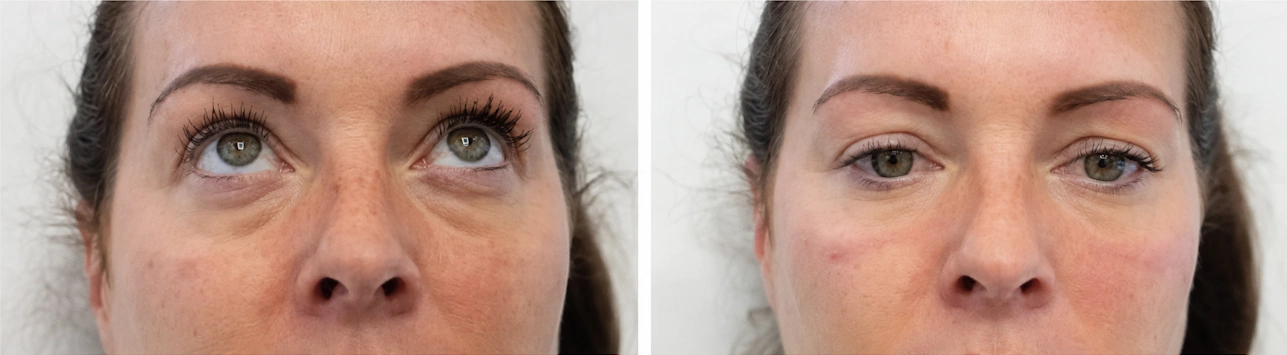
How Useful Are Tear Trough Filler Before-and-After Photographs?
Before-and-after photographs can help demonstrate a practitioner’s approach, but they should not be treated as a guarantee of an individual result.
When reviewing tear trough or under-eye filler before-and-after images, consider whether:
- The patient’s starting anatomy resembles your own
- The photographs use similar lighting
- Head position and facial expression are comparable
- The time between treatment and the final photograph is stated
- The result appears proportionate rather than simply maximally filled
A good photographic result in one patient does not establish whether filler is appropriate for another. The tear trough filler treatment page provides further information about the treatment and examples of results at Dr Nyla Medispa.

Book in a Free Consultation With Our Expert Team
- Award-winning, doctor-led aesthetic clinics
- Locations in London, Cheshire, and Liverpool
- Over 50 non-surgical treatments available
- Free consultation with a personalised plan
Tear Trough Filler Cost UK FAQs
Is the tear trough filler price usually for both eyes?
Usually, tear trough treatment is planned across the under-eye region as a whole rather than pricing the left and right eye independently. However, clinic pricing structures differ, so confirm exactly which areas and how much product are included.
Is 1ml usually enough for under-eye filler?
Many patients can be treated conservatively with 1ml or less across the under-eye area, but there is no universal amount. The appropriate volume depends on the depth of the hollow, facial anatomy, cheek support, skin quality, and whether direct tear trough filler is suitable.
Does a review include a free tear trough filler top-up?
Not necessarily. A clinic may include a review while charging separately for any additional filler required. The review and additional-product policy should be explained before treatment.
Will I always need cheek filler with tear trough filler?
No. Cheek filler is not routinely required for every tear trough patient. It may be considered where reduced midface support contributes to the under-eye hollow, but this should follow individual facial assessment.
Can under-eye filler treat dark circles?
It may improve dark circles where shadowing caused by an under-eye hollow is an important factor. It does not directly remove pigmentation or visible blood vessels, so treatment depends on the cause of the darkness.
Can tear trough filler remove eye bags?
Filler does not remove lower-eyelid fat. It may soften the transition around mild prominence in selected patients, but significant eye bags, puffiness, fluid retention, or festoons can make direct filler inappropriate.
Does tear trough filler cost more for men?
Pricing is generally determined by the treatment plan rather than sex. Men and women can have different facial proportions and patterns of volume loss, but the cost should reflect the product quantity, anatomical areas being treated, practitioner, and clinical service required.
Tear Trough Filler Cost at Dr Nyla Medispa
Tear trough filler pricing is most meaningful when it follows a detailed assessment of the lower eyelid and midface rather than being based on a predetermined quantity of product.
At Dr Nyla Medispa, tear trough filler treatment starts from £350. Our dermal filler treatments are performed exclusively by GMC-registered doctors within a medically regulated clinic, with an individualised approach based on your assessment, suitability, facial anatomy, and desired outcome. Final pricing is provided following a free consultation before treatment.
Your doctor will assess whether direct tear trough filler is appropriate, how much product is likely to be required, and whether cheek or midface support should form part of the treatment plan. Where another approach is more suitable for the under-eye concern, this can be discussed during consultation.
Dr Nyla Medispa has clinics in Mayfair London, Alderley Edge Cheshire, and Crosby Liverpool.
If you are considering tear trough or under-eye filler, you can book a free consultation to discuss your suitability and receive an individual treatment plan. For questions relating to an existing treatment, contact Dr Nyla Medispa or call 0800 009 6661.
Need Guidance in Selecting the Most Appropriate Treatment?
Related Treatments

Tear Trough Fillers

Dermal Fillers

Jawline Fillers

Lip Fillers

Dermal Fillers for Men

About the Author
Considering treatment? Book a free consultation at our clinics in Mayfair London, Alderley Edge Cheshire, or Crosby Liverpool, or call 0800 009 6661.