
Skin Tightening Treatments Explained: Ultrasound, Radiofrequency, RF Microneedling, and Other Options
Clinical guidance from Dr Nyla Raja MBChB (Hons), MRCGP (Dist), DFFP, DPDermatology - GMC No. 6057913
Skin Tightening Treatments: At a Glance
Non-surgical skin tightening includes several different technologies rather than one standard procedure. Ultrasound, radiofrequency, RF microneedling, laser, and plasma treatments deliver energy to tissue in different ways and at different depths. This affects what each treatment can address, the number of sessions commonly required, downtime, and the expected result.
The most appropriate treatment depends on the underlying cause of the concern. Mild skin laxity may be suitable for ultrasound or radiofrequency treatment, while RF microneedling can be particularly relevant where reduced firmness exists alongside texture changes or selected acne scars. Laser and plasma technologies may be considered where skin quality and resurfacing are also important.
Treatment selection should therefore begin with anatomy and clinical assessment rather than choosing a device by name. Skin thickness, degree of laxity, facial volume, fat distribution, treatment area, previous procedures, downtime preferences, and the degree of improvement being sought all need to be considered.
- Ultrasound: delivers focused energy at selected tissue depths and is commonly used for lifting and tightening concerns
- Radiofrequency: creates controlled heating within tissue and may be used for facial or body skin firmness
- RF microneedling: combines microneedling with radiofrequency energy and may address texture alongside laxity
- Laser: treatment characteristics vary considerably, with some technologies particularly relevant to resurfacing and skin quality
- Plasma: creates controlled tissue effects using plasma energy, with indications and downtime dependent on the technology
No non-surgical device can remove substantial excess skin or reproduce the degree of tissue repositioning achievable with surgery. Treatment selection should therefore be based on anatomy, indication, and realistic expectations.
How Do Non-Surgical Skin Tightening Treatments Work?
Most non-surgical skin tightening technologies create a controlled tissue response using energy.
The energy source differs between devices, but the broad principle is to generate controlled thermal or mechanical stimulation within selected tissue layers. This can initiate tissue contraction, repair signalling, and longer-term collagen remodelling.
The important distinction is where the energy is delivered and how it reaches the tissue.
Ultrasound can focus energy beneath the skin surface at predetermined depths. Surface radiofrequency heats tissue through externally applied electrodes. RF microneedling uses needles to deliver energy directly into selected dermal or subdermal levels. Laser and plasma technologies interact with tissue differently again, depending on the device and treatment settings.
These differences influence:
- The concerns a treatment may be suitable for
- Treatment depth
- Whether texture is addressed alongside laxity
- The number of sessions commonly required
- Downtime
- Discomfort
- Potential risks
- Overall treatment cost
Skin Tightening Treatment Comparison
| Technology | Energy Delivery | Common Treatment Focus | Typical Treatment Approach | Downtime |
|---|---|---|---|---|
| Focused ultrasound | Focused acoustic energy at selected depths | Mild to moderate laxity, lifting, and definition | May begin with a single treatment depending on the technology | Usually limited visible downtime |
| Surface radiofrequency | Controlled thermal energy through the skin surface | Skin firmness, facial and body laxity, selected contouring concerns | Often performed as a course | Generally minimal |
| RF microneedling | Microneedles deliver RF energy at selected depths | Firmness, texture, fine lines, and selected acne scars | Often performed as a course | Temporary redness, swelling, and sensitivity may occur |
| Laser | Light energy, varying by wavelength and device | Texture, resurfacing, fine lines, sun damage, and selected laxity concerns | Device and indication dependent | Variable |
| Plasma | Plasma energy, depending on the system | Skin quality, texture, fine lines, and selected laxity concerns | Technology dependent | Variable |
The table is deliberately broad. Treatment depth, energy delivery, settings, and protocols vary between devices within each category.
Ultrasound Skin Tightening
Ultrasound treatments use acoustic energy rather than laser or radiofrequency.
Focused ultrasound can generate controlled thermal points within selected tissue layers while largely bypassing the skin surface. This allows treatment of deeper tissue without creating the same form of surface injury associated with ablative resurfacing.
Ultrasound treatment may be considered for concerns including:
- Lower-face laxity
- Early jowling
- Reduced jawline definition associated with skin laxity
- Loose neck skin
- Brow laxity
- Selected décolletage concerns
Different ultrasound platforms should not be treated as interchangeable simply because they use the same broad energy category.
Ultherapy
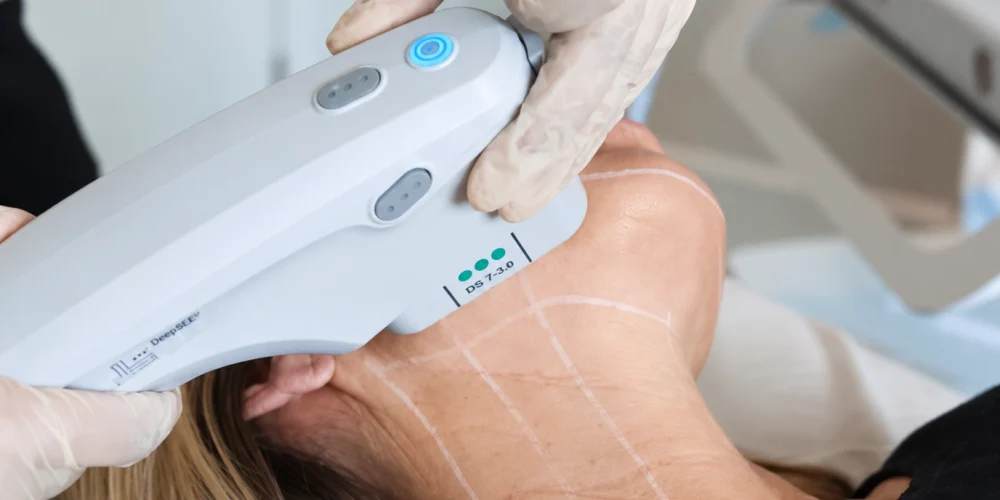
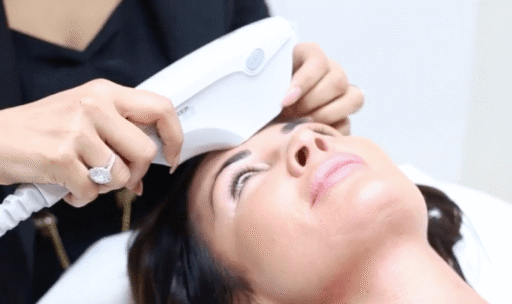
Ultherapy is a microfocused ultrasound treatment that uses real-time ultrasound visualisation during treatment.
Different transducers allow energy to be delivered at selected tissue depths. It may therefore be considered where the treatment objective involves lifting and tightening rather than surface resurfacing.
Common treatment areas include the brow, lower face, jawline, under the chin, neck, and décolletage.
A systematic review of microfocused ultrasound for facial skin tightening identified measurable improvements across the included studies, particularly in areas including the brow and submental region. The review also identified variation in study design, protocols, and outcome assessment, which is important when interpreting the evidence.
Many patients begin with one treatment and allow time for collagen remodelling before deciding whether further treatment is appropriate. Temporary redness, tenderness, swelling, tingling, or sensitivity can occur.
Sofwave
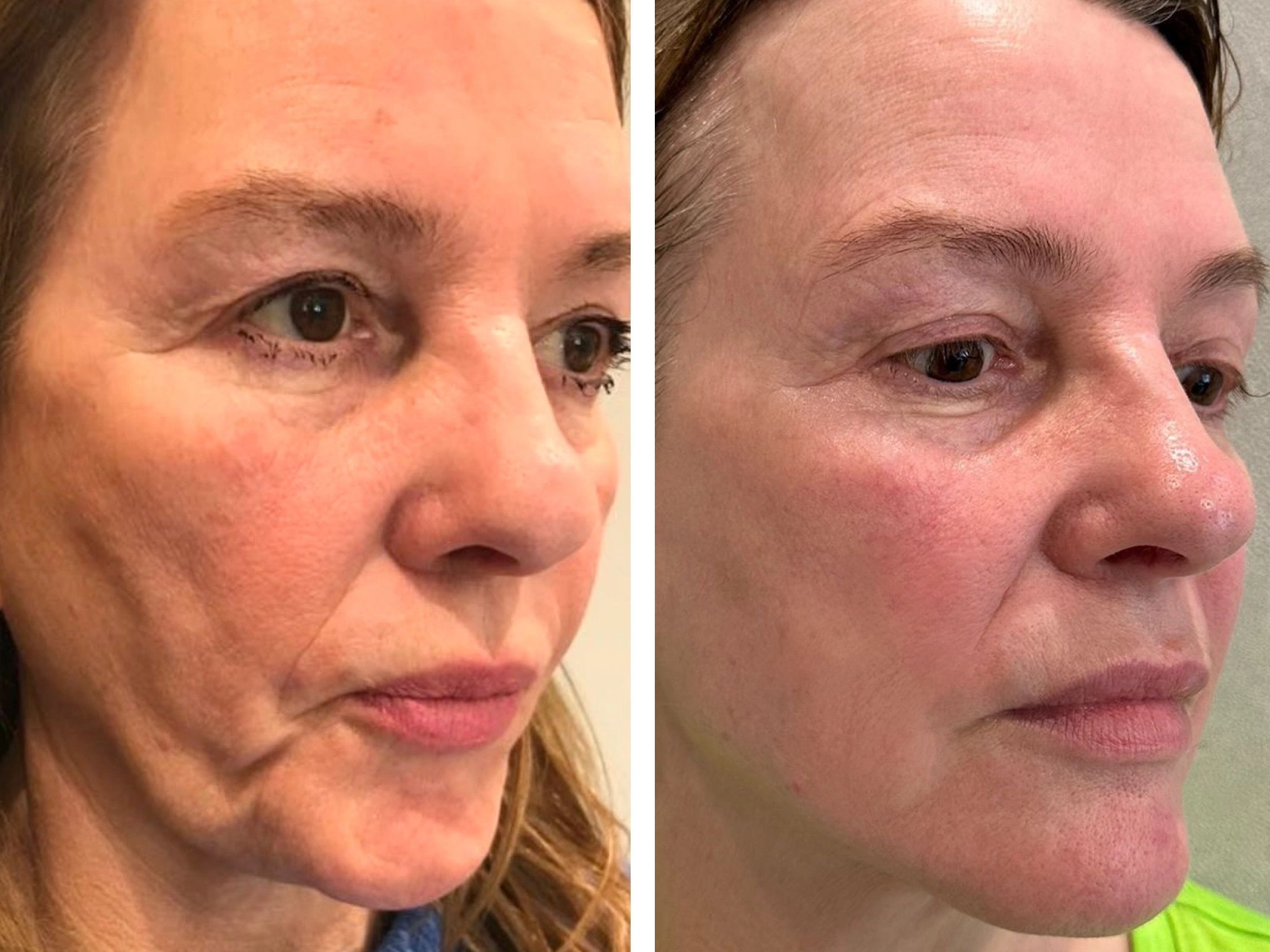
Sofwave is also an ultrasound-based skin tightening treatment, but it is not the same technology as Ultherapy.
Sofwave delivers controlled ultrasound energy primarily within the dermis while integrated cooling helps protect the skin surface. It may be considered where mild to moderate skin laxity and reduced firmness are important components of the concern.
Potential treatment areas include the face, jawline, neck, décolletage, and selected body areas.
Ultherapy and Sofwave should therefore not be compared solely on the basis that both use ultrasound. Their energy delivery and treatment depths differ, which can influence patient selection.
Radiofrequency Skin Tightening
Radiofrequency uses electrical energy to generate controlled heat within tissue. Unlike laser, it does not rely on a specific wavelength of light.
The treatment objective is generally to create controlled thermal stimulation that supports collagen contraction and subsequent remodelling.
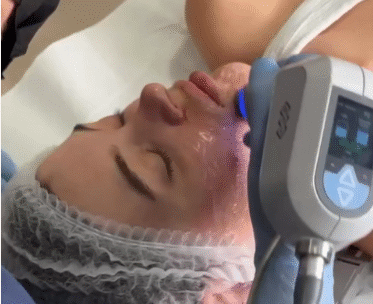
At Dr Nyla Medispa, radiofrequency-based technologies include NuEra Tight and Exilis Elite.
These treatments may be considered for selected facial and body concerns involving reduced firmness or mild to moderate laxity. Depending on the platform and treatment plan, radiofrequency may also form part of body contouring treatment.
Surface radiofrequency generally differs from RF microneedling because the energy is applied through the skin rather than delivered through needles.
RF Microneedling
RF microneedling combines two controlled treatment mechanisms: microneedling and radiofrequency energy.
Fine needles enter the skin to predetermined depths, where radiofrequency energy is delivered into the targeted tissue. This creates both mechanical and thermal stimulation.
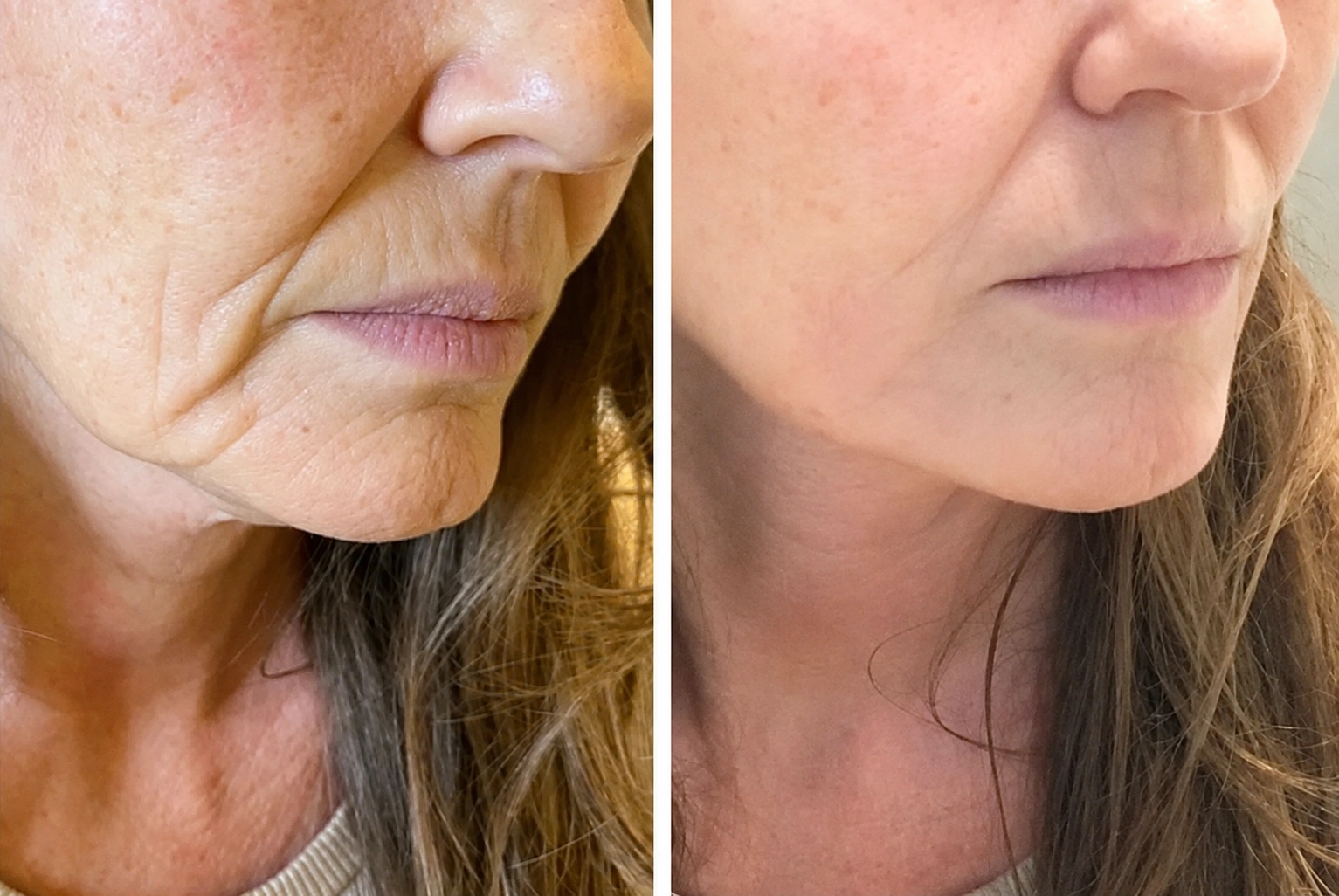
Morpheus8 is one RF microneedling treatment available at Dr Nyla Medispa. It may be considered where reduced skin firmness exists alongside concerns such as uneven texture, fine lines, or selected acne scars.
Our guide explaining Morpheus8 covers the technology, collagen remodelling, treatment depth, and clinical limitations in more detail.
A 2026 systematic review of RF microneedling for facial rejuvenation reported improvements in aesthetic outcomes across the included studies, particularly skin texture and tightening, although protocols and the quality of the underlying evidence varied.
RF microneedling also has a different risk profile from surface radiofrequency. In October 2025, the US Food and Drug Administration issued a safety communication on RF microneedling following reports of complications with certain uses of RF microneedling devices, including burns, scarring, fat loss, nerve damage, and disfigurement.
This does not mean these complications are expected following treatment. It reinforces the importance of patient selection, anatomical knowledge, appropriate treatment depth, energy settings, practitioner training, and clinical follow-up.
Laser Skin Tightening and Resurfacing
Laser is another broad category rather than one standard treatment. Different wavelengths, pulse durations, and delivery methods produce different tissue effects.
Some laser technologies are primarily used for resurfacing and skin quality rather than deeper lifting. Depending on the device, treatment may improve concerns such as:
- Fine lines
- Sun damage
- Uneven texture
- Selected acne scars
- Surface ageing
Dr Nyla Medispa offers treatments including Lumenis UltraPulse CO2 Laser Resurfacing and MOXI Laser Treatment.
More intensive resurfacing can involve greater downtime than ultrasound, conventional radiofrequency, or some RF microneedling procedures. It is therefore inaccurate to compare all “laser tightening” treatments as though they represent one standard procedure.
Plasma-Based Skin Treatments
Plasma technologies create controlled tissue effects using plasma energy rather than ultrasound, conventional radiofrequency, or laser light.
Different plasma systems operate in different ways, so treatment depth, downtime, and indications vary.
NeoGen Plasma is one plasma-based treatment offered at Dr Nyla Medispa for selected skin rejuvenation concerns.
Depending on assessment, plasma treatment may be considered where the treatment objective includes improvements in skin quality, fine lines, texture, and selected forms of laxity.
It should not be assumed that all treatments using the term “plasma” work in the same way.
Face, Neck, and Body Skin Tightening Require Different Treatment Plans
A treatment that is appropriate for mild facial laxity does not automatically translate directly to the abdomen, upper arms, or inner thighs.
Face
Facial treatment needs to take account of skin quality, fat compartments, bone structure, facial volume, and muscle activity.
A softer lower face may result from laxity, but it may also be influenced by jawline anatomy, facial volume loss, or localised fat.
Neck
Neck treatment requires assessment of the skin alongside submental fat, platysmal activity, and underlying facial and neck structure.
Significant excess neck skin cannot generally be corrected to a surgical degree using an energy-based treatment alone.
Body
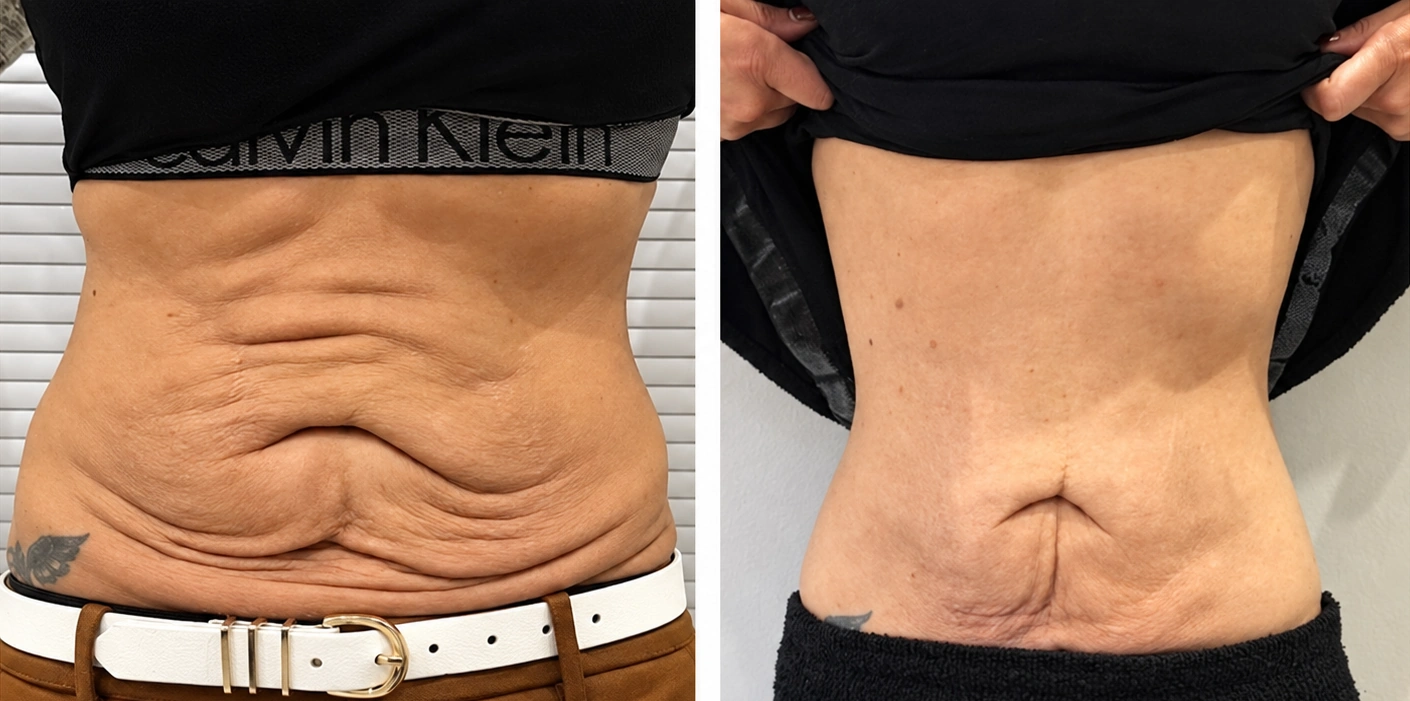
Body skin tightening may be considered for areas including the abdomen, upper arms, thighs, and knees. Treatment fields can be larger than those on the face, while skin thickness and the amount of underlying fat can vary considerably.
Device selection and treatment planning should therefore be specific to the anatomical area.
Which Skin Tightening Treatment Is Designed for Which Concern?
Mild Facial Laxity
Ultrasound or radiofrequency treatments may be considered where the principal concern is mild to moderate laxity without a significant need for resurfacing.
Jawline and Early Jowling
Ultrasound or selected radiofrequency technologies may be considered where skin laxity contributes to reduced definition.
However, sagging jowls can also reflect changes in facial fat, volume, structural support, and skeletal anatomy. Tightening the skin alone will not necessarily address every component.
Loose Neck Skin
Ultrasound, radiofrequency, and RF microneedling may all be considered for selected neck concerns. The appropriate option depends on skin thickness, degree of laxity, submental fat, muscle activity, and the intended result.
Texture and Laxity Together
RF microneedling may be particularly relevant where the objective includes both collagen remodelling and improvement in skin texture.
Fine Lines, Sun Damage, and Surface Texture
Laser or selected plasma technologies may be considered where surface skin quality is an important part of the concern.
Facial Volume Loss
Skin tightening does not replace lost structural volume. Where facial volume loss is a significant component of facial ageing, a different or combined treatment strategy may be required.
Why Does Treatment Depth Matter?
The depth at which energy is delivered influences which tissue is affected.
This is one of the most important distinctions between skin tightening technologies. A treatment acting primarily within the dermis cannot be assumed to produce the same anatomical effect as a device designed to deliver focused energy into deeper tissue.
Equally, deeper treatment is not automatically more appropriate. The required depth depends on the tissue responsible for the concern.
Treatment planning should therefore consider:
- Skin thickness
- Depth of laxity
- Facial or body anatomy
- Fat distribution
- Previous procedures
- The intended treatment effect
Appropriate depth is particularly important with technologies capable of delivering energy into subdermal tissue, where excessive or unintended treatment can affect structures that are not part of the clinical objective.
How Many Skin Tightening Treatments Are Usually Needed?
The number of sessions varies by technology and patient.
Some ultrasound treatments may begin with one session followed by several months of collagen remodelling. Conventional radiofrequency and RF microneedling treatments are more commonly performed as a course, depending on the device and clinical objective.
The number of treatments should not be determined by a generic package alone. Factors such as baseline laxity, treatment area, skin quality, response to previous sessions, and the degree of improvement being sought should influence the plan.
More sessions do not automatically produce a better result.
Which Skin Tightening Treatments Have the Most Downtime?
Downtime varies substantially between technologies.
Non-invasive ultrasound and surface radiofrequency treatments generally involve relatively little visible recovery. Temporary redness, swelling, warmth, tenderness, or sensitivity may still occur.
RF microneedling creates controlled needle channels and can therefore involve redness, swelling, pinpoint bleeding, dryness, or temporary sensitivity.
Laser and plasma procedures vary most widely. Some involve limited recovery, while more intensive resurfacing can require a longer period of redness, peeling, crusting, or skin-barrier recovery.
The expected recovery should therefore be discussed for the exact procedure being proposed rather than for “skin tightening” as a general category.
What Can Non-Surgical Skin Tightening Not Treat?
Understanding the limitations of treatment is as important as understanding its potential benefits.
Non-surgical skin tightening cannot:
- Remove substantial excess skin
- Reproduce a surgical facelift or neck lift
- Restore significant facial volume loss
- Correct every cause of jowling
- Remove large deposits of localised fat simply by tightening the skin
- Correct abdominal muscle separation
- Stop the natural ageing process
Significant laxity following substantial weight loss can be particularly difficult to treat non-surgically because an energy-based procedure cannot physically remove redundant skin.
The purpose of assessment is therefore to determine whether skin laxity is sufficiently responsible for the concern for tightening treatment to provide a meaningful improvement.
Clinical Note from Dr Nyla Raja
Different devices are designed to create different tissue effects. The most appropriate treatment is determined by the anatomy and the concern being treated, rather than selecting a technology because it is currently popular. In some patients, skin tightening is appropriate; in others, volume, fat, muscle activity, skin texture, or significant excess tissue may be more important.
How Should You Compare Skin Tightening Treatments?
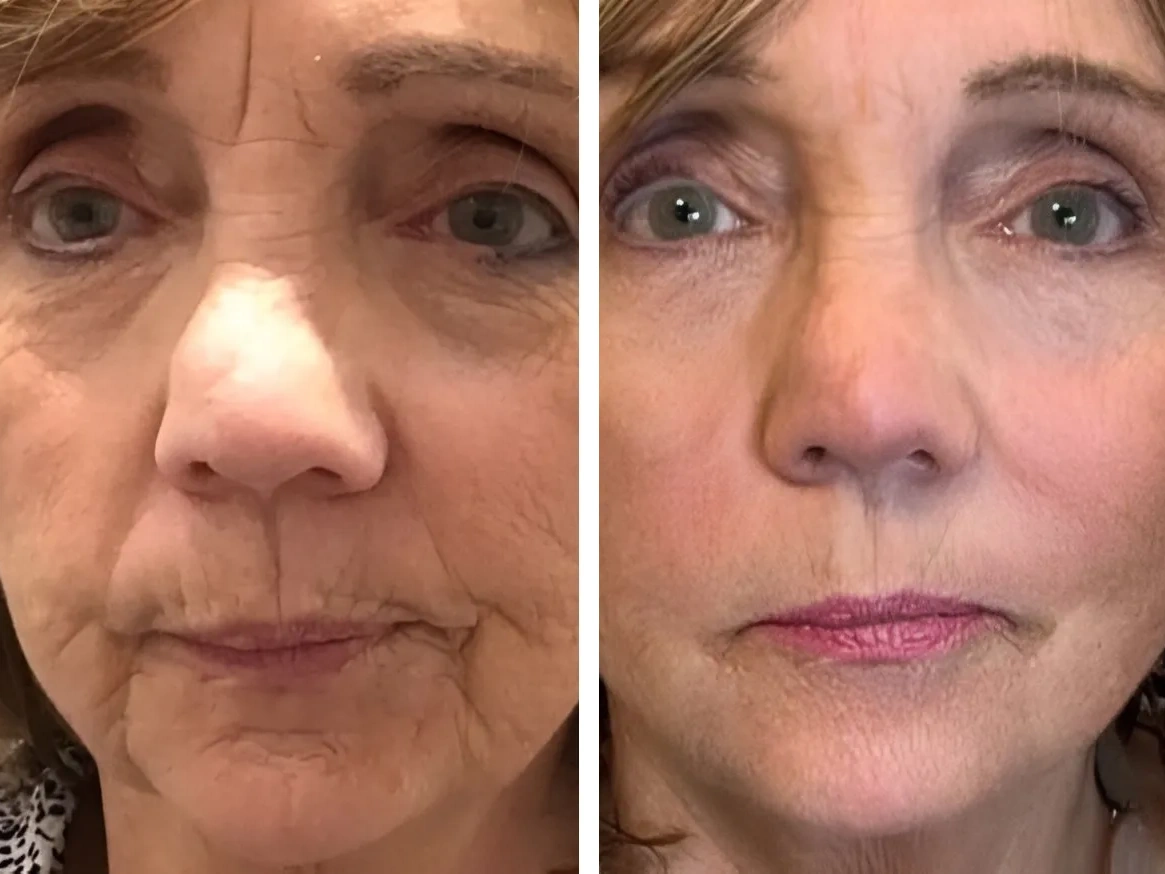
A useful comparison should consider more than before-and-after photographs or the name of the device.
Questions to consider include:
- What tissue is causing the concern?
- What type of energy does the treatment use?
- At what depth is the energy delivered?
- Does the treatment address texture as well as laxity?
- How many sessions are likely to be required?
- What downtime is expected?
- Who will perform the procedure?
- What training do they have with the device?
- What are the potential adverse effects?
- What happens if the result is limited?
- What is the complete treatment-course cost?
The NHS guidance on choosing a cosmetic practitioner recommends checking qualifications, training, experience, insurance, and aftercare arrangements before proceeding with a cosmetic procedure.
For doctors performing cosmetic interventions, the GMC guidance for cosmetic interventions sets out professional expectations around assessment, consent, continuity of care, safety, and responding to complications.
Skin Tightening at Dr Nyla Medispa
At Dr Nyla Medispa, treatment planning is based on the patient’s anatomy and underlying concern rather than using one device for every form of skin laxity.
Available technologies allow different treatment characteristics to be considered according to the required tissue depth, treatment area, skin quality, and whether concerns such as texture or localised fat are also present.
During consultation, we assess:
- The degree and location of skin laxity
- Skin thickness and quality
- Facial or body anatomy
- Volume distribution
- Localised fat where relevant
- Previous treatments
- Medical suitability
- Downtime preferences
- Treatment objectives
- Whether non-surgical tightening is likely to provide a meaningful improvement
The aim is to determine which treatment approach is proportionate to the concern and to explain the expected benefits, limitations, recovery, and potential risks before proceeding.

Book in a Free Consultation With Our Expert Team
- Award-winning, doctor-led aesthetic clinics
- Locations in London, Cheshire, and Liverpool
- Over 50 non-surgical treatments available
- Free consultation with a personalised plan
Skin Tightening Treatment FAQs
What is the most effective skin tightening treatment?
There is no single treatment that is most appropriate for every patient. Ultrasound may be useful for selected lifting and tightening concerns, while RF microneedling may be more relevant where texture and laxity need to be addressed together. Surface radiofrequency, laser, and plasma technologies have different indications again.
Is radiofrequency better than ultrasound for skin tightening?
Neither technology is universally better. They deliver energy differently, can target different tissue levels, and often use different treatment schedules. The more appropriate option depends on the anatomy, concern, and intended treatment outcome.
What is the difference between Ultherapy and Sofwave?
Both are ultrasound technologies, but they work differently. Ultherapy uses microfocused ultrasound with real-time visualisation and can deliver energy at selected depths. Sofwave delivers ultrasound energy primarily within the dermis. They should not be considered interchangeable treatments.
What is the difference between RF and RF microneedling?
Conventional radiofrequency applies energy through the skin surface. RF microneedling inserts fine needles into the skin and delivers radiofrequency energy at selected depths. RF microneedling also creates a controlled microneedling injury, which can make it relevant where texture or selected scars are present alongside laxity.
Can skin tightening help sagging jowls?
It may improve selected cases where skin laxity contributes to early jowling. More pronounced jowls can also reflect tissue descent, facial volume change, fat distribution, and skeletal anatomy, so tightening alone may not address the entire concern.
Can skin tightening improve a loose neck?
Selected ultrasound, radiofrequency, RF microneedling, and other energy-based treatments may improve mild to moderate neck laxity. Significant excess skin cannot be removed with an energy-based treatment and may require surgical assessment where substantial correction is sought.
What is used for stomach skin tightening?
Radiofrequency, RF microneedling, ultrasound, and other body-focused technologies may be considered depending on the degree of laxity and skin quality. Abdominal concerns should also be assessed for localised fat and muscle separation because these require different treatment strategies.
Does skin tightening remove fat?
Not necessarily. Skin tightening and fat reduction are different treatment objectives. Some energy-based platforms can influence both tissue types depending on the device and settings, but a treatment intended primarily for collagen remodelling should not automatically be expected to provide meaningful fat reduction.
How long does non-surgical skin tightening take to work?
Collagen remodelling is gradual. Some early change may be visible, but improvement commonly develops over the following weeks and months. The timeframe depends on the technology, treatment intensity, anatomical area, and individual biological response.
How long do skin tightening results last?
Duration varies according to the technology, treatment course, skin quality, age, and individual response. Skin continues to age after treatment, so maintenance may be considered where clinically appropriate.
Can loose skin after weight loss be tightened without surgery?
Mild residual laxity may improve with non-surgical treatment in selected patients. Where substantial redundant skin remains following significant weight loss, energy-based treatment cannot physically remove the excess tissue, and surgical assessment may be more appropriate if a substantial change is desired.
Choosing a Skin Tightening Treatment
Ultrasound, radiofrequency, RF microneedling, laser, and plasma treatments all sit within the broad category of non-surgical skin tightening, but they are not interchangeable.
The clinically useful distinctions are how each technology delivers energy, which tissue levels it targets, whether it also addresses surface texture, the expected downtime, the number of sessions commonly required, and whether the patient’s concern is actually caused by skin laxity.
For mild to moderate laxity, several non-surgical approaches may be appropriate. Where there is substantial excess skin, significant facial volume loss, pronounced tissue descent, or another anatomical cause, a different treatment strategy may provide a more proportionate approach.
You can book a free consultation at Dr Nyla Medispa in Mayfair, London, Alderley Edge, Cheshire, or Crosby, Liverpool, to discuss your concerns and determine which treatment approach may be appropriate.
Need Guidance in Selecting the Most Appropriate Treatment?
Related Treatments

Skin Tightening
Ultherapy Skin Tightening
Exilis Elite Skin Tightening

Sofwave Skin Tightening

NuEra Tight Skin Tightening

ULTRAcel Q+ Skin Tightening
Ultraformer 3 HIFU Skin Tightening

XERF Skin Tightening

About the Author
Considering treatment? Book a free consultation at our clinics in Mayfair London, Alderley Edge Cheshire, or Crosby Liverpool, or call 0800 009 6661.