
Microneedling vs Profhilo: Which May Be Better for Texture, Hydration or Early Laxity?
Clinical guidance from Dr Nyla Raja MBChB (Hons), MRCGP (Dist), DFFP, DPDermatology - GMC No. 6057913
Neither microneedling nor Profhilo is universally better. The more suitable option depends on what is driving the concern. Profhilo is usually considered where dehydration, fine crepiness, reduced elasticity, and early diffuse laxity are the priority. Microneedling, particularly radiofrequency microneedling, is often the more targeted option for uneven texture, enlarged pores, and selected depressed acne scars.
At Dr Nyla Medispa, both are selected as skin-quality treatments, but they work in different ways. Profhilo is an injectable hyaluronic acid skin-remodelling treatment, while microneedling uses controlled needle-based stimulation. Dr Nyla Medispa’s microneedling treatments combine this with radiofrequency energy. They can sometimes form part of a wider plan, but they should not be treated as interchangeable.
The quick answer: choose the concern, not the trend
| Primary concern | May be more suitable | Why |
|---|---|---|
| Dehydrated, crepey, less elastic skin | Profhilo | Aims to support hydration, elasticity, and overall skin quality. |
| Uneven texture or visible pores | Radiofrequency microneedling | Targets collagen remodelling within the skin, with improvements developing progressively. |
| Depressed acne scars | Radiofrequency microneedling | More directly addresses scar-related textural change. Active acne should be managed first. |
| Early, diffuse loss of firmness | Either, depending on assessment | Profhilo focuses on skin quality; microneedling may be selected where texture and collagen remodelling are also priorities. |
| Significant loose skin or loss of facial structure | Neither alone | A different skin-tightening, structural, or surgical approach may be more appropriate. |
How Profhilo and microneedling differ
Profhilo: an injectable treatment for skin quality
Profhilo contains stabilised hyaluronic acid and is injected at selected points in the treatment area. It is not intended to behave like a conventional dermal filler: it does not primarily create cheek volume, sharpen a jawline, or alter facial contours. Instead, it is intended to support hydration, elasticity, smoothness, and the appearance of mild crepiness or early laxity.
An initial Profhilo course often involves two sessions around four weeks apart. Improvements develop gradually through the treatment course, rather than appearing as an immediate structural change. It may be particularly appealing if skin looks tired, dehydrated, or less supple, but there is no pronounced scarring or surface irregularity to correct.
Microneedling: a treatment for remodelling texture
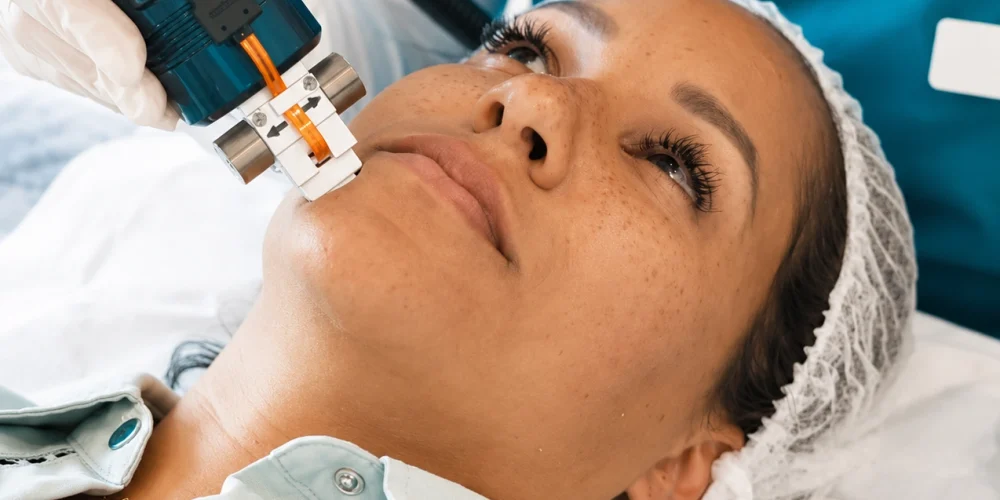
Microneedling creates controlled micro-injuries that stimulate the skin’s repair response. At Dr Nyla Medispa, INTRAcel and Morpheus8 combine microneedling with radiofrequency energy, allowing treatment to be tailored to the area, skin condition, and treatment objective.
This makes radiofrequency microneedling especially relevant for uneven texture, enlarged pores, fine lines, and selected atrophic acne scars. It can also support gradual improvement in mild laxity, although it does not remove excess skin or reproduce a surgical lifting result.
Evidence for radiofrequency microneedling is strongest in areas such as acne scarring and texture. A 2025 systematic review found that fractional radiofrequency microneedling was likely to be effective for acne scars, while also noting the need for larger, well-designed trials to establish optimal treatment parameters. Profhilo has evidence for improvements in selected measures of hydration, elasticity, and laxity, but outcomes remain individual and should be viewed as progressive skin-quality improvements rather than a substitute for lifting or volumising treatment.
Clinical Note from Dr Nyla Raja
Clinical assessment at Dr Nyla Medispa considers whether the main concern is diffuse skin quality or a structural textural change. Hydration, crepiness, pore visibility, acne scarring, active inflammation, pigmentation history, skin sensitivity, and the degree of laxity can all affect the most appropriate treatment choice. A treatment that improves skin hydration is not necessarily the treatment that will most directly improve a depressed scar, and vice versa.
Downtime and treatment experience
Both treatments are non-surgical, but their visible recovery can be different.
- After Profhilo: temporary raised injection points, mild redness, swelling, tenderness, or bruising can occur. The small injection-site elevations usually settle as the product disperses. The degree of visible downtime varies by treatment area and individual response.
- After radiofrequency microneedling: temporary redness, warmth, sensitivity, dryness, or mild swelling are expected as the skin recovers. Downtime varies with treatment intensity, treatment area, and individual skin response.
If you need to be camera-ready for an important event, it is sensible to discuss timings in advance rather than assuming that either treatment will have no visible after-effects.
What about skin of colour and pigmentation risk?
Radiofrequency microneedling may be suitable for a broad range of skin tones because radiofrequency energy is delivered beneath the skin surface, rather than relying on pigment targeting in the way some laser treatments do. That does not mean treatment should be selected without assessment. Any procedure that causes inflammation can trigger post-inflammatory hyperpigmentation in people who are prone to dark marks after spots, eczema, injury, or previous treatment.
A history of pigmentation, melasma, irritation, or prolonged marks after acne should therefore be discussed before treatment. Settings, treatment intervals, skincare preparation, sun protection, and aftercare may all matter. Profhilo does not directly treat significant pigmentation or sun damage, even where improved hydration makes skin appear healthier overall.
When microneedling may need to wait
Microneedling is generally postponed where skin is actively inflamed, infected, sunburnt, or healing from a recent procedure. Active inflammatory acne should be managed before scar-remodelling treatment is considered. A history of keloid scarring, slow wound healing, recurrent cold sores, inflammatory skin conditions, medication use, or recent treatment may also require an individual clinical review.
This reflects the wider principle in the GMC’s guidance on cosmetic interventions: patients should have a clear discussion about likely benefits, limitations, risks, and alternatives before deciding whether to proceed.
Can you have Profhilo and microneedling together?
Sometimes, but not automatically. A staged approach may be considered when there is more than one concern, such as dehydrated, crepey skin alongside enlarged pores or established textural scarring. The sequence and spacing should be determined by the treatment area, skin recovery, the technology used, and your wider plan.
For more noticeable laxity, significant volume loss, pronounced jowls, or excess skin, neither treatment should be presented as a complete answer. Assessment may identify a different non-surgical treatment, a combination approach, or the need to set more conservative expectations.
The key point
Profhilo may be the better choice when the priority is hydration, elasticity, mild crepiness, and early diffuse laxity without a need for facial volume. Radiofrequency microneedling may be the better choice when texture, pores, or selected depressed acne scars are the main concern.
The best decision is not about choosing the most popular treatment. It is about identifying whether the skin needs hydration and bioremodelling, collagen-focused textural remodelling, a different treatment altogether, or a carefully planned combination.
Need Guidance in Selecting the Most Appropriate Treatment?

About the Author
Considering treatment? Book a free consultation at our clinics in Mayfair London, Alderley Edge Cheshire, or Crosby Liverpool, or call 0800 009 6661.