
How Long Does Non-Surgical Rhinoplasty Last? Nose Filler Longevity and Maintenance
Clinical guidance from Dr Nyla Raja MBChB (Hons), MRCGP (Dist), DFFP, DPDermatology - GMC No. 6057913
Non-surgical rhinoplasty results typically remain visible for up to 18 months, although this varies between individuals. The improvement does not usually disappear suddenly: the effect tends to soften gradually, and the appropriate time for any further treatment depends on your current nasal contour, previous filler history, and whether additional volume remains suitable.
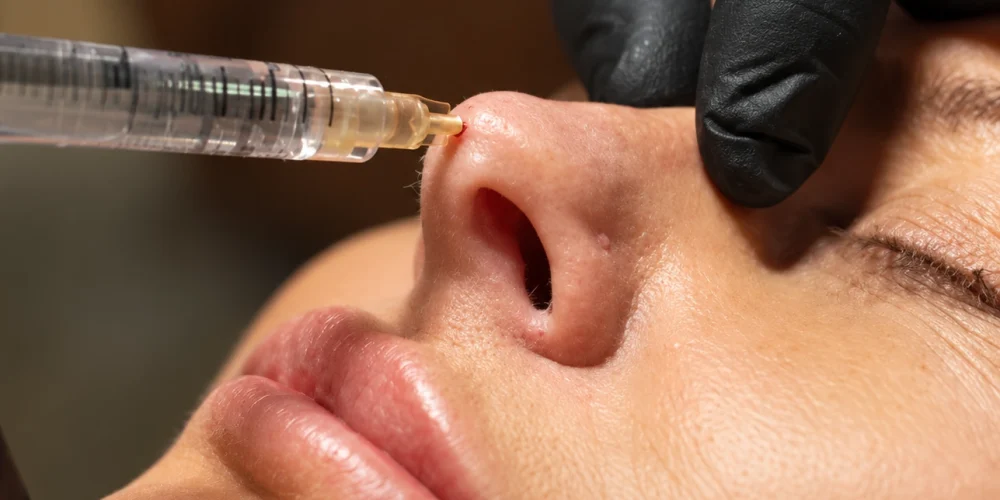
At Dr Nyla Medispa, non-surgical nose reshaping uses carefully placed dermal filler to create smoother, more balanced lines. It can help to camouflage a dorsal hump, support a drooping tip, refine minor asymmetry, or improve bridge definition. It does not make the nose smaller, correct significant structural concerns, or replace surgical rhinoplasty where reduction or functional correction is required.
What does “up to 18 months” mean in practice?
Longevity describes how long the aesthetic improvement remains noticeable, not a fixed expiry date for filler. Some people may feel their result has softened earlier, while others continue to see a pleasing change for longer.
In the nose, even a small change in contour can be visually meaningful. This means the perceived duration of treatment is influenced not only by how the filler changes over time, but also by your starting anatomy, the precise treatment goal, and how closely you notice subtle changes in profile or symmetry.
Results are visible immediately, but early swelling can temporarily affect the appearance. It is therefore sensible to assess the settled result rather than judge the final contour on the day of treatment.
Why nose filler longevity varies
No practitioner can responsibly guarantee an exact number of months. Dermal filler longevity is affected by a combination of product, anatomy, treatment planning, and individual biology.
| Factor | Why it matters |
|---|---|
| Filler product | Different hyaluronic acid fillers have different physical properties and are selected according to the tissue and objective. |
| Placement and amount | Precise placement is central to contour, support, and a natural-looking result. More filler is not a reliable way to make a result last longer. |
| Nasal anatomy | Skin thickness, bridge shape, tip support, and existing asymmetry affect both the treatment plan and how changes are seen over time. |
| Individual response | Metabolism, tissue quality, natural ageing, and previous treatments can all influence how a result evolves. |
| Previous filler | Residual product from earlier treatment may affect whether further filler is appropriate. |
The properties of hyaluronic acid filler, including its formulation and cross-linking, can influence how it behaves and persists in tissue. However, this does not mean that one product or plan will give every patient the same duration.
Clinical Note from Dr Nyla Raja
Non-surgical nose reshaping at Dr Nyla Medispa is intended to create balanced, natural-looking refinement using carefully placed dermal filler. Repeat treatment should be considered in the context of the current nasal contour, facial proportions, the change being sought, and any previous filler, rather than as an automatic top-up at a fixed interval.
Does nose filler completely disappear when the visible result fades?
Not necessarily. It is important to distinguish between a visible aesthetic effect becoming less noticeable and every trace of filler having disappeared.
MRI research into hyaluronic acid filler persistence has identified residual filler in the mid-face for longer than traditional visible-duration estimates in some patients. This research does not establish that nasal filler lasts for the same period, nor does it mean that the original cosmetic result remains unchanged for years. It does, however, support a cautious approach: the date of your last treatment alone cannot confirm that there is no remaining product.
For this reason, it is particularly important to tell your practitioner about any previous nasal filler, including treatment performed elsewhere. If possible, bring information about the product used, treatment area, approximate date, and whether you have ever had filler dissolved or experienced a complication.
When should non-surgical rhinoplasty be maintained?
There is no universal maintenance schedule. A review may be appropriate when the original improvement has gradually reduced and you would like to discuss whether further treatment would still improve the nasal contour safely and proportionately.
At review, the decision should be based on what is present now, rather than simply the number of months since treatment. A clinician may consider:
- how much of the original correction remains;
- whether there is already sufficient support or volume in the treated area;
- changes in nasal contour, facial balance, or aesthetic goals;
- your full previous filler and surgical history; and
- whether waiting, using a different approach, or not adding filler is the better option.
A conservative review is especially important with repeat nose filler. Non-surgical rhinoplasty works by adding carefully controlled volume to create more balanced lines; it is not a treatment where routinely adding more product will necessarily improve the result.
When more nose filler may not be the right next step
Further treatment may not be appropriate if the existing result remains well balanced, the history of previous filler is unclear, or additional volume could compromise proportion or contour. In some circumstances, discussion may instead focus on allowing the area to settle, assessing whether existing filler should be reviewed further, or considering a surgical opinion.
Surgical rhinoplasty may be the more suitable conversation for someone who wishes to reduce the size of the nose, correct a marked deviation, address breathing difficulties, or make a substantial structural change. Dermal filler cannot remove tissue or correct functional nasal problems.
Why maintenance planning matters more in the nose
The nose is a vascularly complex area, and nasal filler should never be treated as a routine beauty top-up. Expert consensus guidance classifies the nose among the highest-risk facial areas for filler-related vascular occlusion. Although this complication is uncommon, it can be serious, which is why anatomy, product selection, conservative technique, patient suitability, and prompt recognition of concerns all matter. CMAC vascular occlusion guidance also highlights the importance of robust emergency management for high-risk areas.
Short-term effects after treatment can include swelling, redness, tenderness, or bruising, and their duration varies between individuals. However, severe or escalating pain, unusual blanching or mottled discolouration of the skin, visual symptoms, or neurological symptoms after nasal filler require urgent assessment. Our guide to non-surgical rhinoplasty risks and urgent warning signs explains this in more detail.
The key point on nose filler longevity
Non-surgical rhinoplasty can provide a visible improvement for up to 18 months, but that range is an estimate rather than a timetable for repeat injections. The safest and most natural-looking approach is to review the nose as it is now, account for previous filler, and only consider further treatment when it remains appropriate for your anatomy and goals.
Need Guidance in Selecting the Most Appropriate Treatment?

About the Author
Considering treatment? Book a free consultation at our clinics in Mayfair London, Alderley Edge Cheshire, or Crosby Liverpool, or call 0800 009 6661.