
Botox Around the Eyes Explained: What It Can and Cannot Treat

Clinical guidance from Dr Nyla Raja MBChB (Hons), MRCGP (Dist), DFFP, DPDermatology - GMC No. 6057913
Botox Around the Eyes: At a Glance
Botox around the eyes is primarily used to soften expression lines caused by repeated contraction of the muscles surrounding the eye, particularly crow’s feet, or lateral canthal lines. Botulinum toxin type A temporarily reduces selected muscle activity, allowing these dynamic lines to appear less pronounced when smiling or squinting.
The eye area is anatomically complex. Wrinkles, under-eye hollows, dark circles, puffiness, eye bags, brow position, and loose skin may occur in the same region but have different underlying causes. Botox is therefore appropriate for some eye-area concerns but not others.
- Primary cosmetic use: dynamic crow’s feet around the outer eyes
- How it works: temporarily reduces nerve signalling to selected muscles
- What it may improve: lateral eye lines caused predominantly by muscle movement
- Brow position: carefully planned treatment can influence the balance of muscles around the brow in selected patients
- Under-eye treatment: may occasionally be considered for selected dynamic lower-eyelid lines, but requires careful assessment
- What Botox cannot correct: tear trough hollowing, pigmentation, prominent eye bags, significant puffiness, or substantial loose skin
- Results: develop gradually rather than immediately and are temporary
The correct treatment depends on identifying whether an eye-area concern is caused by muscle activity, volume loss, pigmentation, fluid retention, fat-pad prominence, skin quality, or skin laxity. These problems should not be treated as interchangeable.
How Does Botox Work Around the Eyes?
Botox is a brand of botulinum toxin type A, a prescription-only medicine used to temporarily reduce activity in selected muscles.
Muscles contract when nerves release a chemical messenger called acetylcholine. Botulinum toxin temporarily reduces the release of acetylcholine at the treated nerve endings, weakening contraction within the targeted muscle.
Around the eyes, this is particularly relevant to the orbicularis oculi, the circular muscle responsible for closing the eyelids and contributing to facial expression.
When the outer portion of this muscle repeatedly contracts during smiling and squinting, the overlying skin folds and creates lateral eye lines. Reducing excessive activity can soften these lines without physically filling them.
The objective should not be to eliminate every movement around the eye. Smiling, blinking, and eyelid function are important, so dose and placement need to preserve normal expression and function.
Crow’s Feet and Lateral Eye Lines
Crow’s feet, also known as lateral canthal lines, are the fine lines that extend from the outer corners of the eyes.
They are produced largely by repeated contraction of the orbicularis oculi and commonly become more visible when smiling, laughing, or squinting.
Where these lines are predominantly dynamic, Botox can reduce the strength of contraction and make them less pronounced during expression.
Treatment patterns vary because crow’s feet do not look identical in every patient. Some lines fan mainly towards the temples, while others extend lower towards the upper cheek or higher towards the brow.
Assessment therefore considers the individual smile pattern, brow position, lower-eyelid support, facial asymmetry, and the amount of movement the patient wishes to retain.
Clinical Note from Dr Nyla Raja
The aim around the eyes is usually softening rather than complete immobility. Natural eye expression is an important part of the face, so treatment should reduce excessive folding while preserving a normal smile.

Dynamic vs Static Lines Around the Eyes
The distinction between dynamic and static lines helps determine what Botox can realistically achieve.
Dynamic Eye Lines
Dynamic lines appear mainly when the muscles contract.
Crow’s feet that become visible during smiling but largely disappear when the face is relaxed are a typical example. These lines generally respond most directly to botulinum toxin because muscle activity is their principal driver.
Static Eye Lines
Static lines remain visible when the face is at rest.
Years of repeated facial movement can contribute to their development, but skin ageing also becomes increasingly important. Collagen loss, reduced elasticity, sun exposure, skin thickness, and surface texture can all affect how pronounced a static line appears.
Botox may soften the repeated muscular folding that continues to deepen these lines, but it does not physically remove an established crease.
If fine lines remain clearly visible at rest, a skin-quality treatment may sometimes be more relevant than simply increasing the amount of Botox.
How Does Botox Affect Brow Position?
Brow position is determined by the balance between muscles that elevate the eyebrows and muscles that pull them down.
The frontalis muscle raises the brows, while portions of the orbicularis oculi and other muscles around the glabella exert downward influence.
Carefully changing this muscular balance can sometimes produce a subtle alteration in eyebrow position. This is often described as a Botox brow lift.
However, Botox does not physically lift loose tissue. It changes muscle activity.
The effect is therefore modest and anatomy-dependent. Someone with significant upper-eyelid skin excess will not obtain the same result from Botox as they would from a surgical procedure designed to remove excess skin.
Forehead treatment also requires particular caution in patients who naturally use their frontalis muscle to maintain eyebrow height. Excessively reducing forehead activity can make brow or eyelid heaviness more noticeable.
Can Botox Be Used Under the Eyes?
Botulinum toxin can occasionally be considered beneath the eyes in carefully selected patients, but this is different from routine crow’s feet treatment.
Small doses may be considered where activity of the lower orbicularis oculi contributes to fine dynamic lower-eyelid lines or a prominent muscle bulge during smiling, sometimes described as a jelly roll.
Suitability is particularly important because the lower eyelid depends on appropriate muscular tone and anatomical support.
Under-eye Botox does not correct:
- Tear trough hollows
- Dark pigmentation
- Prominent lower-eyelid fat bags
- Fluid retention
- Significant skin laxity
Those concerns may occur in exactly the same anatomical region but arise for entirely different reasons.
What Can Botox Realistically Improve Around the Eyes?
In appropriately selected patients, Botox may:
- Soften dynamic crow’s feet
- Reduce lateral eye lines during smiling
- Reduce excessive folding caused by orbicularis oculi activity
- Soften selected lower-eyelid dynamic lines in suitable patients
- Reduce a prominent lower-eyelid muscle bulge in selected cases
- Subtly influence eyebrow position where muscular balance is contributing
- Reduce the repeated movement that can contribute to expression-line formation over time
The result depends on the starting anatomy, muscle strength, skin quality, existing static lines, and treatment dose.
Botox is most predictable when the concern is clearly related to muscle movement.
What Botox Cannot Treat Around the Eyes
Many common eye-area concerns are not primarily caused by muscle activity.
Botox cannot directly:
- Restore under-eye volume
- Fill a tear trough hollow
- Remove pigmentation or dark skin colour
- Remove prominent fat pads or true eye bags
- Treat significant under-eye fluid retention
- Remove substantial loose eyelid skin
- Restore lost cheek support
- Directly improve skin texture, hydration, or pigmentation
This distinction helps avoid treating every patient with the same injectable simply because the concern is located beneath or beside the eyes.
Botox Does Not Treat Tear Trough Hollowing
A tear trough is a depression between the lower eyelid and upper cheek. When this hollow creates shadowing, it can make the eye area appear darker or more tired.
Botox cannot replace missing volume because it does not add tissue support.
In carefully selected patients, tear trough filler may be considered where genuine hollowing is the principal problem.
Even then, not every under-eye hollow is suitable for filler. Puffiness, fat-pad prominence, skin quality, fluid retention, and cheek support need to be assessed first.
Our guide to under-eye dermal fillers explains the role of volume restoration in more detail.
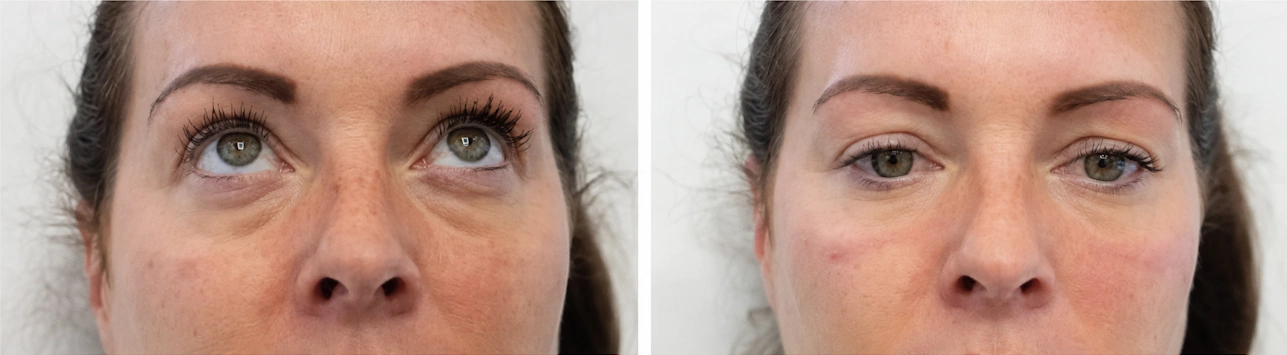
Botox Does Not Remove Dark Circles or Pigmentation
Dark circles can have several causes.
They may result from:
- True skin pigmentation
- Visible blood vessels through thin lower-eyelid skin
- Shadow caused by a tear trough hollow
- Prominent eye bags
- A combination of these factors
Botox does not remove pigment or change the colour of the skin.
If darkness is caused by shadow from a hollow, treating the volume deficit may alter how light falls across the area. If the darkness is genuine pigmentation, a different treatment strategy is required.
Botox Does Not Remove Eye Bags or Puffiness
True lower-eye bags often involve prominence of the lower-eyelid fat pads. Puffiness can also reflect fluid retention, lymphatic factors, allergies, or inflammation.
Botox does not remove fat and does not drain excess fluid.
Patients describing “eye bags” therefore need assessment to establish whether they have hollowing, puffiness, fat-pad prominence, or a combination of concerns.
Our under-eye bags treatment guide explains these differences and the treatment options that may be considered.
Can Botox Tighten Loose or Crepey Skin Around the Eyes?
Botox can make dynamic lines appear smoother because the skin is being folded less strongly by the muscle beneath it.
It does not directly tighten significantly loose skin.
Likewise, fine crepiness, reduced elasticity, dehydration, and textural change are primarily skin-quality concerns rather than muscle problems.
Depending on the individual presentation, treatments such as polynucleotides, skin boosters, microneedling, chemical peels, or appropriate skincare may be considered where improving the quality of the skin is the main objective.
Clinical Note from Dr Nyla Raja
Several different problems can coexist around the eyes. A patient may have crow’s feet from muscle movement, a tear trough from volume loss, pigmentation within the skin, and some laxity at the same time. Good treatment planning means separating those causes rather than expecting Botox to correct all of them.
Botox vs Other Eye-Area Treatments
The most appropriate treatment depends on the anatomical cause of the concern.
| Concern | Common Contributing Factor | Role of Botox |
|---|---|---|
| Crow’s feet | Repeated orbicularis oculi contraction | Often appropriate for dynamic lines |
| Tear trough hollow | Volume and structural anatomy | Does not restore volume |
| Dark pigmentation | Pigment within the skin | Does not remove pigmentation |
| Prominent eye bags | Fat-pad prominence and/or tissue changes | Does not remove fat |
| Puffiness | Fluid retention or soft-tissue factors | Does not treat fluid retention |
| Crepey or lax skin | Skin quality and tissue laxity | May soften movement-related lines but does not directly tighten significant laxity |
Patients with several contributing factors may benefit from a combined treatment strategy, but this does not mean every available treatment should be used. The plan should be limited to interventions that address a clearly identified problem.
Our guide to non-surgical eye treatments compares different approaches to common eye-area concerns.
When Does Botox Around the Eyes Start Working?
The effect develops gradually following treatment rather than appearing immediately.
Reduced muscle activity may begin to become noticeable over the first several days, with the result generally becoming more established over approximately 10–14 days.
Results are temporary. The duration varies according to the muscles treated, dose, individual response, previous treatment, and natural muscle activity.
As the effect gradually wears off, normal neuromuscular signalling returns and movement increases again.
Our guide to how long Botox lasts explains the treatment timeline in more detail.
Is Botox Around the Eyes Safe?
Botulinum toxin type A has an established role in aesthetic medicine, but treatment around the eyes requires detailed understanding of facial anatomy and muscle function.
Common temporary effects can include:
- Redness
- Minor swelling
- Bruising
- Tenderness at injection sites
- Headache
Less commonly, unintended weakness of neighbouring muscles can affect eyebrow or eyelid position. Eyelid or brow drooping is a recognised possible adverse effect.
Rare complications are also possible, which is why Botox remains a prescription-only medicine requiring appropriate assessment and prescribing.
The NHS guidance on choosing a cosmetic practitioner recommends checking qualifications, training, experience, insurance, and aftercare arrangements before undergoing treatment.
Our guides to Botox safety and Botox side effects provide more detailed information on recognised risks and clinical considerations.
What Happens at a Botox Consultation for the Eye Area?
Assessment should establish what is causing the concern before deciding whether Botox is appropriate.
A practitioner may assess:
- Crow’s feet at rest and during smiling
- Orbicularis oculi muscle activity
- Forehead and frown-muscle activity
- Eyebrow position and symmetry
- Upper-eyelid hooding
- Lower-eyelid support
- Static versus dynamic lines
- Tear trough hollowing
- Eye bags or puffiness
- Skin quality and laxity
- Previous injectable treatment
- Your medical and medication history
This assessment helps distinguish a muscular problem from one involving volume, skin, fat, or fluid.
Following treatment, our Botox aftercare guide explains practical considerations including exercise, rubbing, skincare, sleeping, makeup, and normal daily activities.

Book in a Free Consultation With Our Expert Team
- Award-winning, doctor-led aesthetic clinics
- Locations in London, Cheshire, and Liverpool
- Over 50 non-surgical treatments available
- Free consultation with a personalised plan
Botox Around the Eyes FAQs
Is Botox around the eyes mainly for crow’s feet?
Yes. Dynamic crow’s feet at the outer corners of the eyes are one of the most established cosmetic uses of botulinum toxin around the eye area.
Can Botox get rid of all lines around the eyes?
No. It works most directly on lines caused by muscle movement. Static creases, skin laxity, crepiness, and textural changes may remain even after muscle activity has been reduced.
Can Botox remove under-eye hollows?
No. Under-eye hollowing is a volume and structural concern. Botox does not add volume and therefore cannot fill a tear trough.
Can Botox remove dark circles?
Not if the darkness is caused by pigmentation, visible vessels, or shadow from volume loss. Botox only addresses selected muscular activity.
Can Botox get rid of eye bags?
No. Botox does not remove lower-eyelid fat or significant fluid accumulation. Eye bags should be assessed according to their underlying cause.
Can Botox lift the eyebrows?
In selected patients, carefully altering the balance of muscles around the brow can produce a subtle change in eyebrow position. Botox does not physically lift loose skin and cannot reproduce the effect of surgery.
Can Botox make hooded eyes worse?
It can make brow or eyelid heaviness more noticeable in some patients if forehead activity is reduced without adequately considering how much that patient relies on the frontalis muscle to maintain brow height. This is why assessment of brow and eyelid anatomy is important.
Can Botox be injected directly under the eyes?
Small doses can sometimes be considered for selected dynamic lower-eyelid concerns, but this is not appropriate for every patient and requires careful assessment of lower-eyelid anatomy and function.
What is better for under-eye lines: Botox or filler?
They treat different causes. Botox reduces selected muscle activity, while filler restores volume. A dynamic wrinkle and a tear trough hollow therefore require different treatment approaches.
Can Botox improve crepey under-eye skin?
It may reduce movement-related folding in selected areas but does not directly improve the biological quality of crepey skin. Skin-focused treatment may be more appropriate where texture and laxity are the primary concerns.
Botox Around the Eyes: Treating Muscle Activity, Not Every Eye-Area Concern
Botox is most useful around the eyes when repeated muscular contraction is the main cause of the concern. It can soften dynamic crow’s feet and lateral eye lines and, in carefully selected patients, influence other aspects of muscular activity around the brow or lower eyelid.
Its limitations are equally important. Botox cannot restore tear trough volume, remove pigmentation, eliminate prominent eye bags, resolve fluid retention, or significantly tighten loose skin.
A natural-looking result therefore begins by distinguishing muscle activity from volume loss, pigmentation, skin quality, puffiness, fat-pad prominence, and laxity. Treating the correct anatomical cause is more important than treating every visible change with the same injectable.
If you are considering treatment around the eyes, you can book a free consultation to discuss your concerns, suitability, facial anatomy, and the most appropriate treatment plan.
Need Guidance in Selecting the Most Appropriate Treatment?
Related Treatments

Anti-Wrinkle Injections

Dermal Fillers

8 Point Facelift

EMFACE Facial Lifting

About the Author
Considering treatment? Book a free consultation at our clinics in Mayfair London, Alderley Edge Cheshire, or Crosby Liverpool, or call 0800 009 6661.